


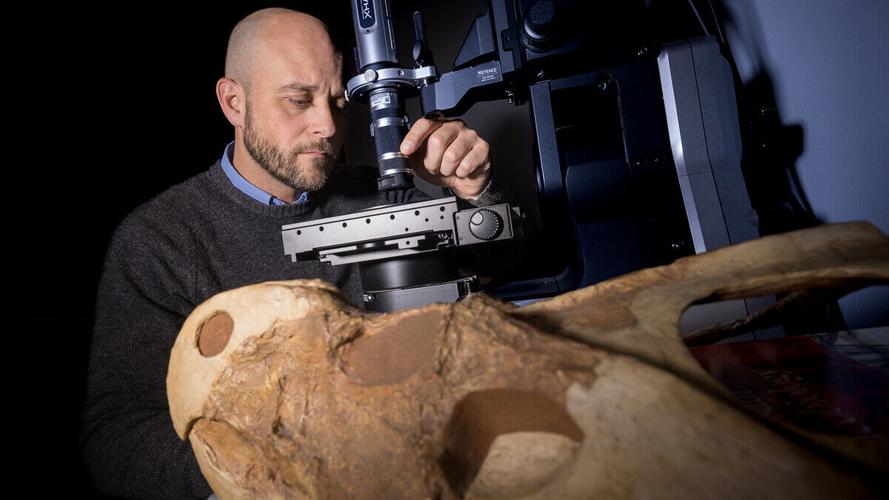
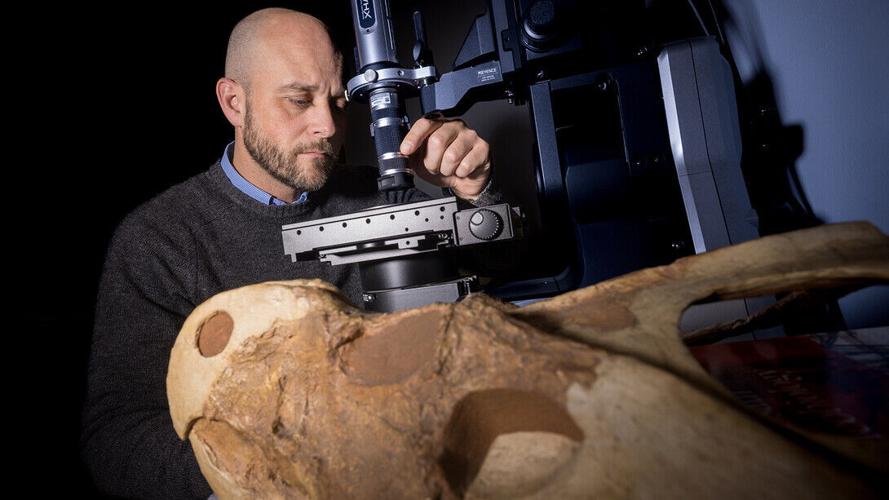
Ashley Poust, a paleontologist at the University of Nebraska–Lincoln, is part of an international team that has identified a previously unknown species of feathered dinosaur.
The new species, Jianchangmavis, is described in a study published in the Annals of Carnegie Museum. The fossil, discovered in China's Changma Basin, represents a member of Microraptorinae, a group of small, feathered dinosaurs closely related to the evolutionary lineage that led to modern birds.
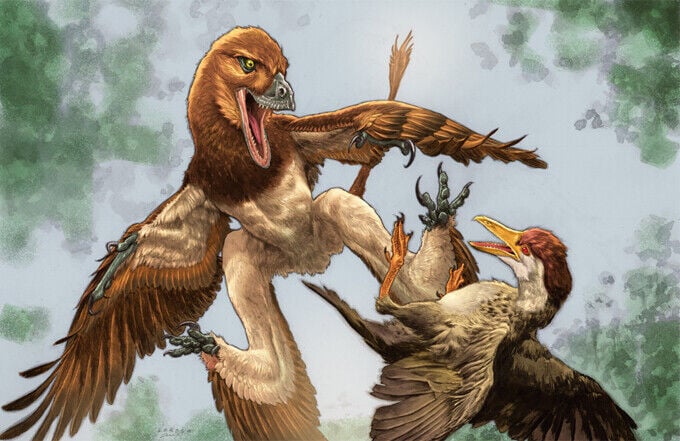
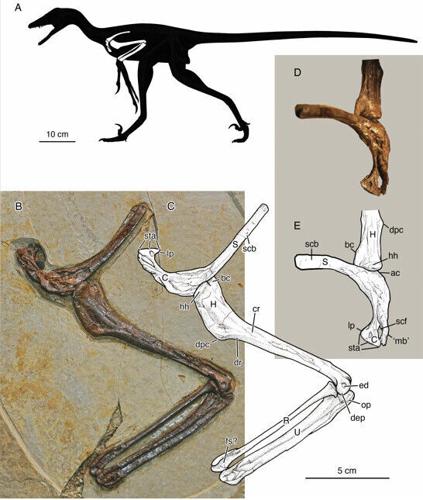
Jianchangmavis was a small predatory dinosaur about the size of a modern barn owl that lived about 120 million years ago in the Early Cretaceous period. Researchers identified it from a partial fossil preserving portions of the shoulder and forelimb, but comparisons with related species suggest it belonged to a group of feathered hunters that occupied an important place in the evolutionary transition between non-avian dinosaurs and birds.
People are also reading…
Poust, Dr. Michael and Jane Voorhies Endowed Curator of Vertebrate Paleontology at the University of Nebraska State Museum, contributed comparative anatomy and evolutionary analyses that helped researchers determine the fossil represented a distinct species.
“I saw this and thought, ‘That’s almost the same as the thing that I had been studying, only larger,’” Poust said of his first encounter with the specimen during a scientific conference presentation years ago. “That was what initially caught my attention.”
At the time, Poust was a graduate student studying small, feathered dinosaurs related to bird origins. After the presentation, he connected with lead author Matt Lamanna of the Carnegie Museum of Natural History. The discussion began a collaboration that included researchers from the Carnegie Museum, Chicago’s Field Museum and institutions in China.
The fossil itself is incomplete, consisting primarily of portions of the shoulder and forelimb preserved in fine-grained lakebed sediments. Despite limited remains, the specimen preserved enough anatomical detail for researchers to compare it with related dinosaurs and test for evolutionary relationships.
Poust helped evaluate how growth, preservation and fossil compression may have affected the specimen's anatomy. He also contributed to the study's phylogenetic analysis, a process that compares hundreds of anatomical characteristics across species to determine where the animal fit within the dinosaur family tree.
The analysis consistently placed the specimen within Microraptorinae, a group known for small-bodied predators with feathers and bird-like features. Members of the group are important to scientists studying the evolution of flight and the transition between non-avian dinosaurs and birds.
Researchers spent years evaluating the fossil before concluding it represented a new species.
“You don’t want to assume something is new just because it’s interesting,” Poust said. “You have to let the evidence take you there.”
The discovery expands understanding of microraptorine diversity and geographic distribution during the Early Cretaceous period. Most known members of the group have been discovered in northeastern China. The Changma specimen, found hundreds of miles away in Gansu Province, suggests these animals occupied a broader range of environments than previously recognized.
“This is just one tiny piece of a much larger puzzle,” Poust said. “But it is helping us move toward a complete picture.”


