


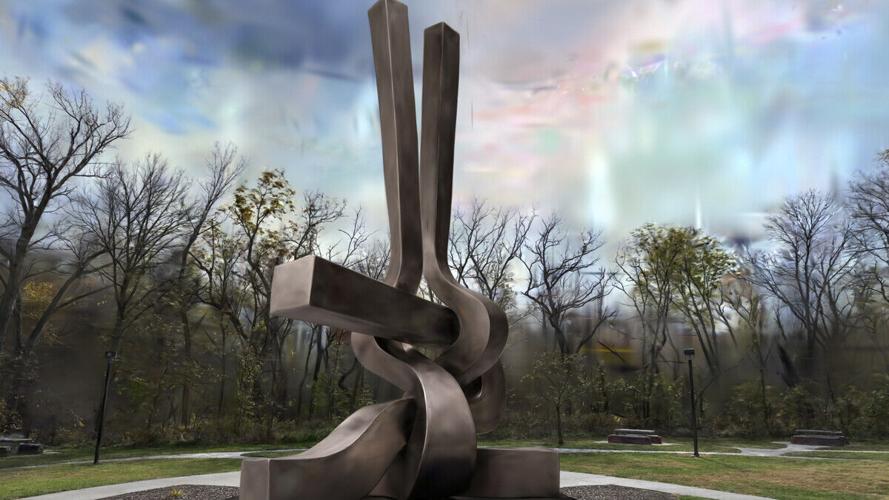
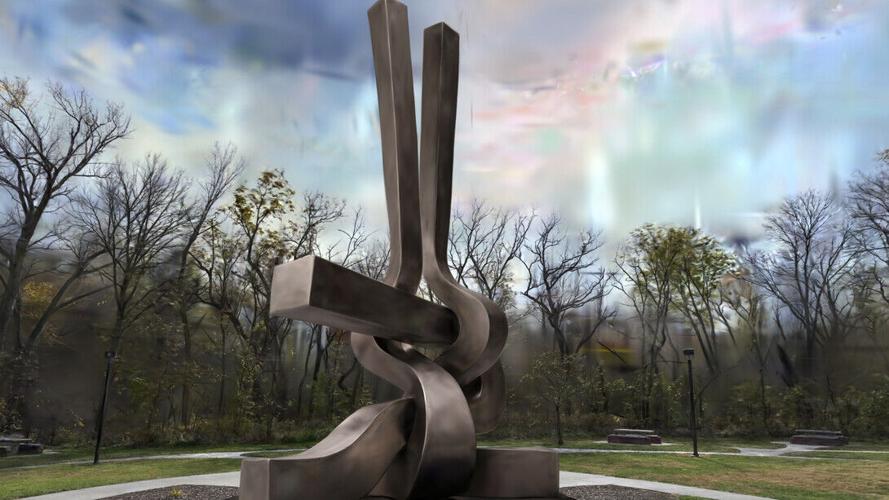
As part of the national America 250 celebrations, the Johnny Carson Center for Emerging Media Arts, through its research and emerging media production team Edgeworks, has digitized and 3D-scanned each of the sculptures included in Nebraska’s Interstate 80 Bicentennial Sculpture Project in collaboration with the Nebraska Arts Council.
In 1976, during the United States’ Bicentennial, Nebraskans commissioned a series of eight modernist sculptures for I-80 rest stops across the state. The sculptures were intended to inspire reflection on the nation’s past and curiosity about its future. The project was led by Thomas A. Yates of Bankers Life Nebraska and Norman Geske, founding director of Sheldon Museum of Art. Nebraska’s “500 Mile Sculpture Garden” was dedicated July 4, 1976.
Meagan Dion, director of public art and artist programs for the Nebraska Arts Council, said the group was interested in expanding access to the sculptures through emerging technologies.
People are also reading…
“As we were reviewing the sculptures and the archives at NAC and at the Nebraska State Historical Society to develop new signs for the rest areas and exhibits about the sculptures, I recognized how they documented the events 50 years ago,” Dion said. “It was interesting to see that even as technology shifts, we always use different technologies in art and recording history or memories. It became apparent that for the 50th anniversary of the sculptures, we should expand accessibility of the artwork and record through the technological tools of today.”
The Edgeworks team 3D-scanned each of the seven remaining sculptures and digitally reconstructed an eighth sculpture that no longer exists using a scale model housed at the Museum of Nebraska Art. The resulting immersive digital models are available now on the Nebraska Arts Council website. The group is also creating an exhibition titled “50th Anniversary of the I-80 Sculpture Garden” to be set up in rest areas near Ashland, Seward, York, Grand Island, Kearney, North Platte and Ogallala.
“Once we deliver the exhibit, the community will keep the exhibit, which will include a large panel of printed historical text and photos, a video created by ONPXL (an Omaha-based digital studio) and the 3D print of the sculpture in that community,” Dion said.
The project combines emerging technologies with historic preservation, making Nebraska’s public art accessible to audiences across the state and beyond.
Alex Gee and Reid Brockmeier, both Carson School emerging media arts alumni, played key roles in the project. Gee created the Gaussian splats, which are highly detailed digital recreations generated from hundreds of photographs, while Brockmeier created printable 3D models and prepared the splats for online viewing.
Lindsey Clausen, project manager at Edgeworks, said the sculpture garden was particularly well suited for digital preservation.
“I think something like the 500 Mile Sculpture Garden makes so much sense to capture in digital format because a sculpture in Ogallala, for example, is not necessarily accessible to someone in Lincoln, and a sculpture in Elkhorn is not necessarily accessible to someone in Ogallala,” she said. “It’s been a great use case for some of these digital tools to have the ability to make distance irrelevant so you can really fully experience the exhibition of sculpture without having to travel the distance.”
The Edgeworks team visited the sculptures at rest stops across the state, capturing extensive photographic data to build the digital models. Some locations presented unique challenges. One sculpture had to be scanned inside a closed rest area after special permission was granted to access the site.
The digital scans allow viewers to rotate, zoom and explore the sculptures from virtually any angle through a web browser or virtual reality headset.
The Gaussian splatting technology creates photorealistic 3D environments from overlapping photographs. Brockmeier described the process as creating “a 3D photograph that you can move around and look at from any angle.”
Unlike traditional 3D scanning methods that often require expensive equipment, Gaussian splatting can be created using standard photography and computer processing. Brockmeier said the technology captures details and textures with remarkable accuracy, making it especially valuable for historic preservation work.
“Emerging technologies like Gaussian splatting will be monumental to preservation of art and history,” Brockmeier said. “Pictures are a great form of documentation, but even better is a 3D picture that you can freely navigate around to see from any angle.”
Brockmeier, now an interactive media developer at Edgeworks, was responsible for adapting the digital scans into models suitable for 3D printing. That process often required extensive reconstruction work.
“3D prints have to be a solid, watertight object with a volume and thickness,” Brockmeier said. “Many of the details of the sculptures have important tiny structures that are integral to their forms.”
Dion said Edgeworks expanded the project’s possibilities beyond what she originally imagined.
“Edgeworks quickly surpassed my technological knowledge limitations,” she said. “Emerging technologies allow creative solutions through a completely new language.”
The project introduced many team members to an overlooked chapter of Nebraska’s artistic history.
“Many people might not recognize Nebraska as being a hub for public art, or they might not even be aware that it’s there,” Brockmeier said. “Fifty years ago, these sculptures were seen as controversial, but they have stood the test of time as beautiful marvels for visitors to see.”
The Mary Riepma Ross Media Arts Center will host a special screening of “500 Mile Sculpture Garden,” a 1976 documentary exploring the visionary I-80 Bicentennial Sculpture Project, from 3 to 4:30 p.m. June 30. The screening is free and open to the public, but seating is limited. Those wishing to attend can RSVP here or call the Ross at 402-472-9100 to reserve tickets.
Following the screening, there will be a panel discussion from 5:30 to 6:30 p.m., with a reception to follow at Sheldon Museum of Art featuring panelists John Raimondi, artist of “Erma’s Desire,” located at the eastbound I-80 rest area near Grand Island; Art Thompson, director of the I-80 Bicentennial Sculpture Project; Dan Worth, Committee to Preserve the I-80 Bicentennial Sculptures; and Karen Janovy, former Sheldon education director.


