


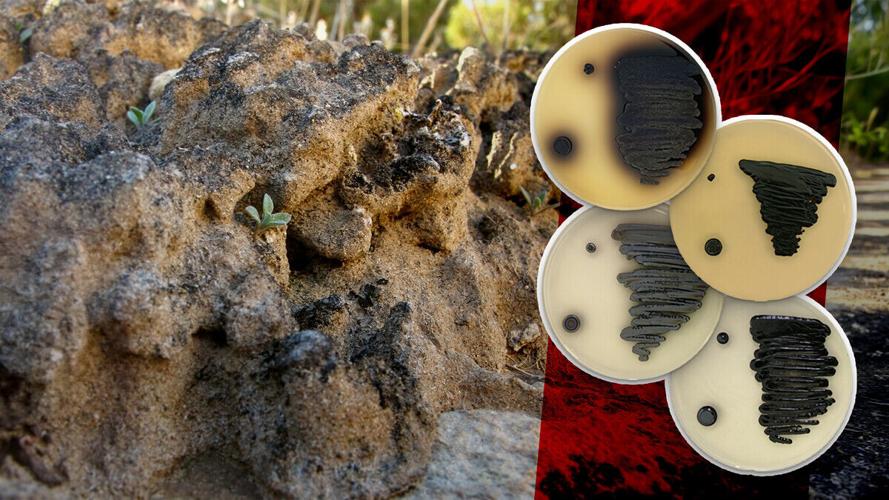
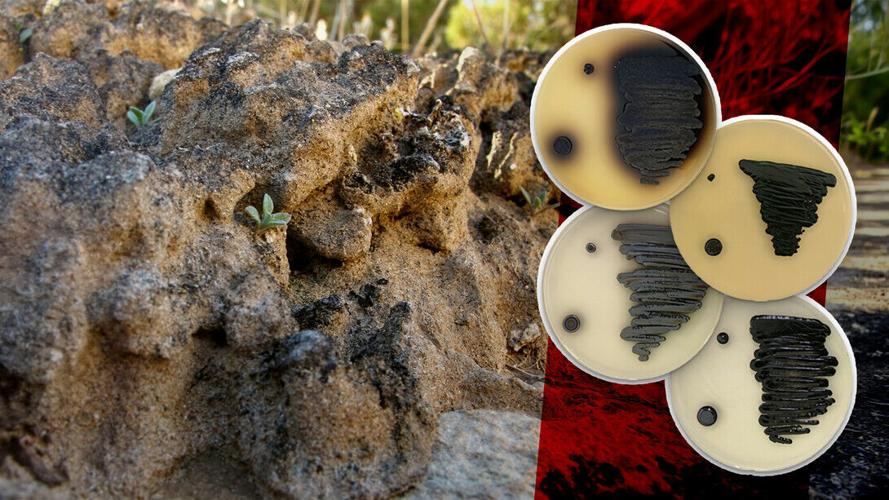

A newly discovered black fungus that thrives in some of Earth’s harshest environments is helping engineering researchers at the University of Nebraska–Lincoln answer a fundamental question: Why would an organism spend valuable resources producing something that benefits others?
That question is at the center of a growing research program led by Rajib Saha, Richard L. and Carol S. McNeel Associate Professor of Chemical and Biomolecular Engineering. With new funding from the U.S. Army DEVCOM Army Research Office ($479,681) and the Air Force Office of Scientific Research ($599,806), Saha’s team is investigating how fungi produce melanin, why some fungi release it into their environment and how that process may help entire microbial communities survive under extreme conditions.
The awards build on an ongoing National Science Foundation project focused on Exophiala viscosa, a fungal species discovered and characterized by researchers at Nebraska.
People are also reading…
Melanin is best known as the pigment that gives color to human skin, hair and eyes, Saha said. In nature, however, it serves a much broader role. Melanin can protect organisms from ultraviolet radiation, oxidative stress, toxic metals, desiccation and other environmental challenges. Because of these properties, researchers have long been interested in melanin as a potential biomaterial for applications ranging from protective coatings to radiation shielding and advanced materials.
“What makes this fungus unusual is not simply that it produces melanin,” Saha said. “It actively releases melanin into its surroundings. That raises an important biological question. Melanin is metabolically expensive to make, so why would a microorganism invest energy producing something that leaves the cell?”
One possibility is that melanin functions as a shared resource within microbial communities. By protecting neighboring algae and cyanobacteria from environmental stress, the fungus may receive essential nutrients in return. Understanding whether such exchanges occur could provide new insight into how microbial partnerships emerge and persist in nutrient-poor environments, Saha said.
The Army-supported project will investigate these interactions directly, Saha said. Researchers will combine synthetic biology, genetics, metabolomics, transcriptomics and computational modeling to determine how metabolites move between organisms and how those exchanges influence community stability.
The Air Force-supported project focuses on the fungus itself. Researchers will examine the genetic and metabolic mechanisms that control melanin production and regulation in a polyextremotolerant organism capable of surviving conditions that would be lethal to most forms of life.
Together with the NSF project, the awards allow the team to study the problem from multiple scales, from genes and metabolic pathways to ecological interactions and community behavior.
“We are building an integrated research effort around a remarkable organism,” Saha said. “The goal is to understand not only how melanin is made, but also why it is produced, why it is secreted and what role it plays in helping microbial communities survive and function.”
The work brings together collaborators from multiple institutions, including Steven Harris at Iowa State University and Yinjie Tang at Washington University in St. Louis. The Nebraska team includes postdoctoral researcher Erin Carr, whose work was instrumental in the discovery and characterization of Exophiala viscosa and in developing the new research directions.
Beyond advancing knowledge of fungal biology and microbial ecology, the research is establishing a foundation for future efforts in engineering non-model microorganisms and developing biologically derived materials with exceptional protective properties.
As the projects move forward, Husker researchers hope to reveal how one unusual fungus can illuminate broader principles governing cooperation, survival and adaptation in the microbial world.


