


A diabetic North Dakota athlete has exhausted his insulin.
At the aquatics center, an athlete with a history of heart problems complains of chest pains.
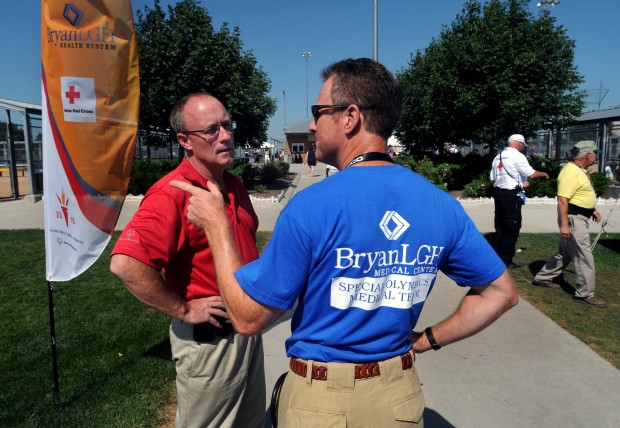
Dr. Ed Mlinek, the medical focal point of Lincoln's games, phones in a prescription for one and authorizes 911 for the other.
Another call: An Iowa runner has had a second bout of diarrhea. He needs to be checked, isolated.
Mlinek calls the leader of the Iowa Special Olympics delegation: "I'm sorry, I'd love to have him compete ..." But he won't.
Mlinek makes a second call, scratching him from Thursday's competition.
It's 10:03 a.m., five hours into a workday that won't end for 12 more hours.
Mlinek's cell phone power shows one bar gone.
People are also reading…
He picks up a portable charger on the dashboard, a lesson learned from 13 days as emergency team leader after Hurricane Katrina.
"When you run out of juice," he says, "what do I do?"
To Lincoln's games, Mlinek, BryanLGH Medical Center's chief of emergency medicine, brings more lessons learned after the terrorist attack of 9/11, from weeks of similar duty following other hurricanes.
He notes a tropical storm heading toward the Gulf oil spill, and says his team -- one of six in the nation -- will be on call starting Sunday. There may not be much of a break after the last plane of Special Olympics athletes takes off from Lincoln at 4:30 p.m. Saturday.
So far, Mlinek says, everything has gone according to the 50-page detailed plan worked out in meetings over two years, monthly at first, and then weekly.
In late June, special instructions were sent to California's delegation after a pertussis outbreak there, but Mlinek knows people don't always follow medical advice.
So far, he says, no pertussis in Lincoln. Two more days, and he can avoid infamy as the doctor associated with a 50-state outbreak.
At the games in Ames, Iowa, four years ago, scores of athletes began vomiting and developed diarrhea because of norovirus.
Mlinek calls Tim Timmons at the Lincoln-Lancaster County Health Department to review the latest illnesses, grouped by dorm, state and sport.
They discern no pattern.
About 10 to 15 patients connected to the games get transported for care daily, Mlinek says. More athletes spend time cooling off in air-conditioned trailers loaned by Lancaster County Emergency Management, or resting on cots made available by the American Red Cross.
Heat, muscle strains, sprains and abdominal distress lead the list of complaints. Seizures, brought on by the athletes' underlying conditions, have been the most serious problems.
No cases of heat stroke have occurred, but there have been precautions. Roaming volunteers push water and sunscreen. Iced towels await distance runners beyond the finish line.
For the games, Mlinek is the medical hub, not the wheel, composed of 600-700 volunteer nurses from BryanLGH, 130 from the Red Cross, plus 40 doctors, physician assistants or advanced practice registered nurses. They're assisted by Midwest Ambulance, ham radio operators, athletic trainers and others.
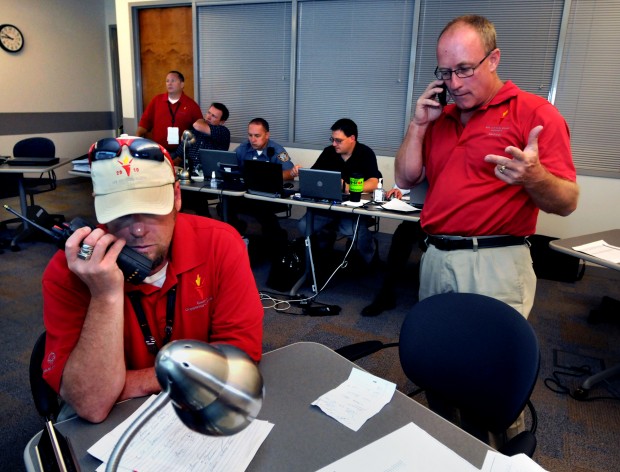
Communication flows through the temporary command post at UNL police headquarters, also home to all police, fire, Department of Defense and central dispatch this week.
It's the same system used for football Saturdays, says UNL assistant chief Carl Oestmann.
Steve Bennett, chief operating officer of the national games, hangs out at one of the desks, commenting on the lucky near misses of various storms.
"We're right in the bubble," he says.
A list of ongoing police and medical calls fills one wall screen. Scenes from nine video cameras fill another. A third shows a large map dotted with Xs, red for current medical, green for fire, blue for police.
"It's fun," Mlinek says of his job. "There's nothing like putting a plan together, seeing it come to fruition and adapting."
He has an oxygen tank, portable defibrillator and large medical kit in the back of his SUV, but the main tool is a telephone, now ringing again, the 31st call in 90 minutes.
A swollen arm of unknown cause ...
A swollen eye, red and mattering ...
A patient vomiting, unable to take sips of water ....
Reach Mark Andersen at 473-7238 or mandersen@journalstar.com.


