


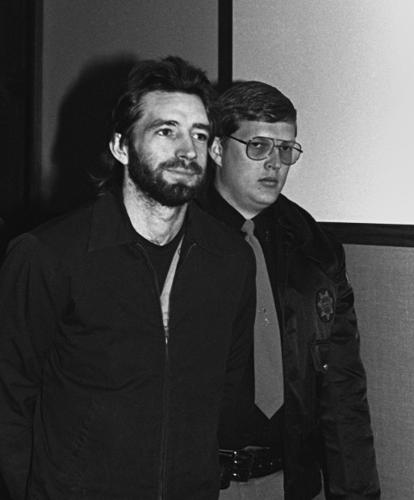
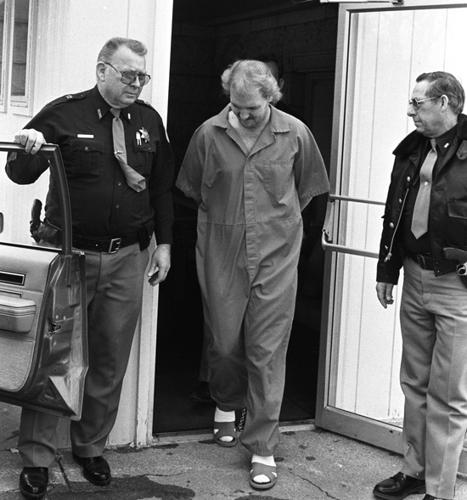
The curious and the connected filled many of the 195 seats in the Jefferson County courtroom for Joseph "Lobo" White's murder trial.
White, 26, walked into the room on Oct. 30, 1989, looking almost professorial in coat, tie and trimmed beard.
A judge had moved the trial 28 miles down the road from Beatrice to the century-old sandstone courthouse in Fairbury. Nearly two dozen relatives of slain Beatrice widow Helen Wilson listened as Gage County Attorney Richard Smith's baritone filled the cavernous room.
Smith had flat-out confessions and guilty pleas from three people charged in Wilson's 1985 rape and murder. He had a no-contest plea from a fourth.
Three of them were ready to place their hands on the Bible and send White to prison for life, or worse.
Over the next nine days they did just that, but 19 years later, DNA testing would decimate their testimony, clear White's name and reveal mistakes in the Wilson case specifically and cracks in the state's criminal justice system in general.
People are also reading…
White's attorney, Toney Redman, couldn't know what was to come on that October morning, but he knew the state's witnesses were both a strength and a weakness for the prosecution. His best bet, it seemed was to cast doubt on them.
Redman asked jurors to weigh the credibility of JoAnn Taylor, James Dean and Debra Shelden.
Taylor, Redman noted, had said she was so high she saw paint bleeding down the walls of Wilson's downtown Beatrice apartment. She also gave investigators several versions of the story. Dean and Shelden, he said, would testify to memories they recovered only through dreams.
Smith stood up for his witnesses, to the degree that he could.
"If the state could bring in a priest or a rabbi or a nun or minister that was there and put them on the stand for you, we would. But these are the people that were there."
Inconsistencies, yes, Smith admitted, but all three would say White was there and that he raped Wilson.
"If you were there and observed that, who wouldn't dream?"
A grisly tale
It all started in a bathroom.
On the night her great-aunt was killed, Shelden testified, Taylor and Dean met to talk in the bathroom of a friend's apartment. Then the three of them went riding around with Tom Winslow and White, who they knew as Lobo.
They ended up at Helen Wilson's apartment. Her great-aunt recognized Shelden and said hello.
Then Taylor and White started shoving the woman around, elbowing Shelden when she tried to stop them, knocking her into a wall so hard her head was bleeding and she passed out.
When Shelden came to, she said her great-aunt was on the living room floor, her hands bound behind her back. Taylor knelt near the woman's head and held a pillow over her face. Winslow held her feet and Lobo straddled her.
"I heard Mrs. Wilson screaming. … She was trying to get up. She was struggling with her head back and forth, trying to get released out of Tom's hand."
When Lobo was finished raping the 68-year-old widow, Winslow rolled her over and took his turn, Shelden testified.
Helen Wilson didn't move any more after that.
In her dreams
Redman came out swinging.
Shelden acknowledged she'd only met Lobo once - on the night of the murder. And she admitted she'd told Redman in August that she didn't know what he looked like.
"Would you agree with me that you've changed your testimony a number of times?"
"Yes."
"What prompted you to change your testimony? Was it a person? Was it dreams? What was it?"
"Nothing. Nobody told me anything. I just did it."
Later, Redman zeroed in on the role of Dr. Wayne Price, a part-time Gage County deputy and a psychologist who had counseled some of the defendants.
"And Dr. Price helped you with your memory regarding those dreams, didn't he?" he asked after Shelden said she didn't initially recall either Kathy Gonzalez or James Dean - the last of the six - being in Wilson's apartment that night.
"Yes," she replied.
"Now, do you remember telling me in the deposition that everything you recalled about this murder you remembered in your dreams?"
"I remember it by seeing it. I know exactly."
"Can you separate for me, Mrs. Shelden, the facts that you recall from your dreams from the facts that you remember from the case or are they identical?"
"They are identical."
'I just froze'
Next on the stand was Dean, the truck driver who had given authorities nine different statements after his arrest.
Dean testified he saw White, Taylor, Winslow and Shelden in Apartment 4.
Jurors had heard Prosecutor Smith detail the injuries, which included broken ribs and a broken arm.
"… and I heard this thud and this crack, and it sounded like a bone breaking," Dean testified. "It sounded like when I broke my ankle.
"I just froze. I didn't know what to do. I wasn't watching, wasn't paying no attention to what was going on."
Still, he gave a vivid description of the rapes. And he said Taylor did more than cover Wilson's face.
"She was holding the hands and licking the upper area of the body of Mrs. Wilson."
He remembered Taylor making coffee, too. And Gonzalez bleeding and holding a brown washcloth to her face.
Back in Winslow's car, Dean said, White and Taylor talked about what had happened.
"Oh, there was general conversation about how nice it was to do it. They would do it again. It was fun."
Redman and his co-counsel bored in on the fact that Dean had given multiple statements, each different from the last. And, they focused on an earlier conversation they'd had with Dean about Joseph White.
"Do you recall at a deposition that you were asked if you could identify him?"
"I wouldn't know him if I seen him."
Taylor's turn
JoAnn Taylor admitted she had held a pillow on Helen Wilson's face.
"… because I didn't want her to see the face that would haunt her."
"Why would the face haunt her?"
"I know from previous experience that when you're raped the face can haunt you."
Taylor offered no explanation for the need to cover a face already wrapped tightly in an afghan.
Her testimony also tied White to a piece of physical evidence.
Lobo, she said, did a trick that ended with him tearing a $5 bill. Exhibit No. 19 in his trial for first-degree murder: part of a $5 bill found on the floor of Apartment 4.
Time for damage control. Redman had Taylor detail her personality disorder and how it had led to memory problems. She also described how she talked telepathically with her fiancé in another state from jail and had a vision in her cell of a woman dressed in Victorian clothing.
And then Redman asked Taylor about vastly different accounts she had given of Helen Wilson's death and how she had come to a version that more closely matched the crime scene.
"Are you telling me that at no time police officers fed information to you to testify to what you have testified to today?"
"I wouldn't say they fed it to me, no, sir."
"… I take it the information that they gave you was pretty influential in helping you remember?"
"Yeah. It helped me sort things out a lot."
"Had they not helped you with information, do you think you would be able to remember anything?"
"No."
In his defense
White took the stand and denied any role in the crime. He'd never done a trick with a $5 bill, he said. He'd never even met Deb Shelden.
And then, his answer to a single question may have determined where he would spend the next two decades.
The prosecutor showed White the church portrait Helen Wilson had given to her children and grandchildren for Christmas right before she was killed.
"Handing you Exhibit No. 1. Can you tell me what that is, if you know?"
"It's a picture of an old woman," White replied flatly.
The defense lawyers winced. They had never thought to prepare their client for such a moment.
"To him, that's what it was, and so Joseph White was being very, very honest," Redman said. "But after all of the drama in this trial, the perception was that he was the most cold-blooded, cold-hearted killer."
The verdict
Before handing the case to the jury, Judge William Rist told the eight women and four men to consider the motive behind eyewitness testimony.
Dean and Shelden both had signed deals that likely would result in sentences of 10 years and actual prison time of about half that long. Prosecutors reduced the charge against Taylor from first- to second-degree murder and agreed to recommend a 15-year sentence.
"You should hesitate to convict the defendant if you decide that their testimony or any of it is false about an important matter and that there is no other evidence to support the testimony."
Jurors began their deliberations at 11:40 a.m. on Thursday, Nov. 9.
They came back at 3:40 p.m.
Guilty.
The Wilson family had endured the entire two-week trial. When asked if the verdict offered relief, son Darrell Wilson pumped his fist in the air and said, "You bet ya … yes."
At his sentencing two months later, White said he was convicted by lies.
"I am not guilty of this crime. I have never been guilty of this crime and even if the sentencing is getting out due to parole, then I will take that opportunity to prove my innocence."
Reach Catharine Huddle at 473-7222 or chuddle@journalstar.com.


