


The railroad was here before just about everybody and everything but the preachers, the government and salt.
Lincoln was trying hard to be a "railroad town" from the first, and it invested dearly to get the tracks to come in and go out. Governments paying "incentives" to bring a new industry to town is not a new idea.
"A city out on the prairie -- even a capital city -- could not be taken seriously without railroad service," says Virtual Nebraska's history of Lincoln.
Voters approved bond issues in 1867, the year Nebraska became a state, 1868 and 1869, offering bounties as high as $100,000 for the first railroad to arrive in Lincoln, according to the histories.
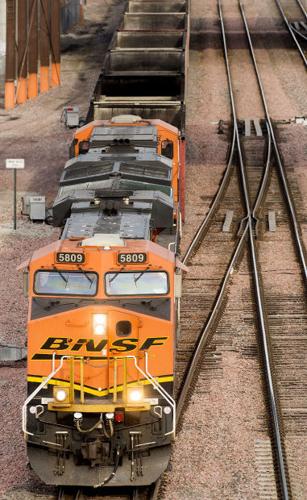
The Burlington & Missouri River Railroad claimed a $50,000 prize when locomotive No. 1, the "Hurricane," steamed into Lincoln on June 26, 1870. The Burlington and other regional railroads reorganized as the Chicago, Burlington & Quincy system, which made Lincoln a rail center of the West. It still is, under the BNSF Railway brand.
People are also reading…
Between 85 and 95 BNSF trains pass through Lincoln on a given day on tracks linking the Powder River Basin in Wyoming and Montana to Kansas City and Chicago.
There are still Union Pacific tracks in town, but just a train or two a day passes through and not a single UP employee is based in Lincoln.
The biggest, oldest industrial employer in Lincoln is and has been BNSF and its predecessors, which makes Lincoln, indeed, a railroad town. For 145 years, through a variety of owners and names, the railroads that became BNSF Railway expanded, contracted and employed thousands of people in Lincoln, often several generations of families.
Frank Eman and Herman Neitzel are retired machinists, a generation apart. Both worked at the car and wheel shops around which Havelock was organized in the 1890s. Their fathers worked there, too.
They grasp the peculiar associations working people have with an employer who has been here for longer than anyone alive can remember. It hasn't always been a warm relationship. There were bitter strikes and reductions in force. The Havelock shops have about 500 employees now. Over the generations, technology has reduced that from three times the number.
Both men go to meetings of railroad veterans, social gatherings of people who worked for the railroad for long periods of time.
"Well, it's been a railroad town as far as I'm concerned," said Neitzel, 82. "I basically never worked for anybody else but the railroad, and Uncle Sam, of course, for a couple of years.
"I started out in '50, probably, worked a couple of summers, and in '53 I worked until I retired in '88. And two years out for the service. Course at that time, your military time counted as railroad time, I think the railroad still does that."
He ended up a wheel shop foreman and still can describe, using obscure terminology in exquisite detail, the steps to overhauling wheel bearings. His dad came from Valparaiso and started work in 1922.
"There were times when it was pretty skinny," Neitzel said. "During the Depression they'd get laid off in the summertime, we'd take the family on an old locomotive to Minnesota, where my mom's relation lived, and we'd help them harvest. We'd be up there sometimes two months, then he'd come back to work.
"I have a brother, Daryl, he's retired also. Worked for the railroad. He went up the ladder on the locomotive shop side. He lives in Prior Lake, Minnesota. He's been all over the railroad. He invented some things, lubricating tread on wheels to make them last longer."
Today, about 2,000 people work for the BNSF in Lincoln, fewer than at its peak, but on a roll amid the revival of U.S. rail traffic carrying coal and oil, consumer goods and construction materials, agricultural commodities and cars.
Eman, 62, describes the work done in Lincoln, how trains are assembled and reassembled in Hobson Yard west of downtown. "We also offload cargo, dispatch crews from here, change crews," he said. "When you see trains on the siding near Waverly, they're sometimes changing crews."
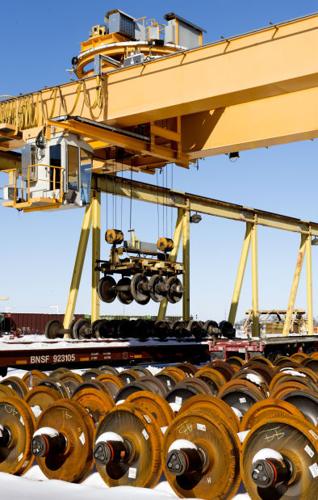
BNSF repairs and maintains cars and assembles wheel sets at Havelock.
"Any part of that car," Eman said, "from wheels, axles, bearings, brake shoes, couplers, primarily for our own system. Repairs on locomotives are done on West O, and we fuel trains out there. We do inspections on trains and cars. Other cities -- Springfield, Missouri; Topeka, Kansas -- they do a lot of what we do. But we're one of the bigger maintenance and repair places, us and Alliance."
The presence of BNSF, with about 5,000 employees statewide, and Union Pacific, with about 8,000, makes Nebraska the third biggest employer of railroaders among the states, behind Texas and Illinois.
Nebraska has the biggest concentration of railroad employment, given its smaller population, according to data from the American Association of Railroads. Railroad payroll in the state was almost $1 billion in 2012, according to the association, and it's undoubtedly more now. BNSF's Nebraska payroll alone was almost $400 million in 2013.
Nebraska has about the same number or more retirees as active railroaders, about 13,000, according to 2013 data from the federal Railroad Retirement Board, which supervises their pensions. Typically, a railroader can retire at age 60 with 30 years of service.
One feature of railroad jobs in his day and age, Eman said, and even now, is that they tended to last.
"This was one place you could spend your life," he said. "It was like Goodyear. You had a job all your life if you didn't screw it up. I enjoyed my time working for the railroad. I was talking to some of the other guys, we're all getting older. When I first started there were a lot of people who had worked on steam. Now everybody goes, 'Steam? What is that?'
"Technology has improved so much, they're getting way more mileage out of wheels, way more mileage out of locomotives, that's just a trend over time."
Train car axles, for example, are now ultrasonically tested for flaws at Havelock, said Superintendent Wade Greisen, a Humphrey native.
BNSF has invested millions of dollars recently in its Lincoln operations, from new fueling stations on West O several years ago to structural and equipment improvements at the Havelock shops, which will celebrate 125 years next year.
Greisen said the Havelock shop maintains 6,000 cars a year, mostly coal and grain cars, and produces 90,000 or more wheel sets.
"We are the only U.S. railroad that owns a wheel plant," he said. "We supply strictly to BNSF, the rest have outsourced."
After almost 125 years, still using some original buildings, the Havelock shops needed upgrading. They're replacing the building siding, and tearing down walls in a combination of structural and equipment upgrades.
BNSF is contemplating how to celebrate the 125th anniversary of the Havelock shops next year.
It will have a lot of people watching, and not just locally. Railroads have lots of followers, Railfans, who study its history and mark its progress in minute detail. They write books, collect passenger train china and other antiques, contribute to blogs, shoot and share pictures and gather at events to talk about railroads. They are as intently interested as those who worked there and retired and still gather every month with former colleagues.
Neitzel admits to sharing a certain sentimentality about the work he did with Railfans.
"Oh, yeah, I've got a lot of little railroad gidgets at home," he said.


