


Lincoln's first train, on the Burlington & Missouri River Railroad, arrived from Plattsmouth on July 26, 1870, a momentous enough occasion for the weekly Nebraska State Journal to begin daily publication. The Midland Pacific arrived from Nebraska City in 1871 and the Atchison & Nebraska from Atchison, Kansas, in 1872. Both would come into the Burlington fold.
By 1882, the Burlington had reached Denver and in 1894 had opened a through connection to the Pacific Northwest at Billings, Montana. The B&MR became part of the Chicago, Burlington & Quincy in 1904 and Burlington Northern in 1970. In 1995, Burlington Northern and Santa Fe merged to form what is now BNSF Railway. On Feb. 12, 2010, BNSF became a subsidiary of Omaha-based Berkshire Hathaway.
When building west from Lincoln in 1871, the Burlington named its new stations in alphabetical order: Asylum, Berks, Crete, Dorchester, Exeter, Fairmont, Grafton, Harvard, Juniata, Kenesaw and Lowell (other stations, like Friend and Sutton, would eventually break up the pattern). It crossed another "ABC railroad," the St. Joseph & Denver City (now part of the Union Pacific), and built northwest from Fairbury: Alexandria, Belvidere, Carleton, Davenport, Edgar, Fairfield, Glenvil and Hastings.
People are also reading…
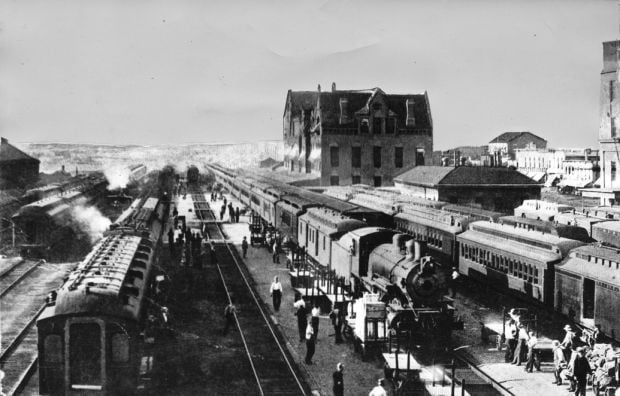
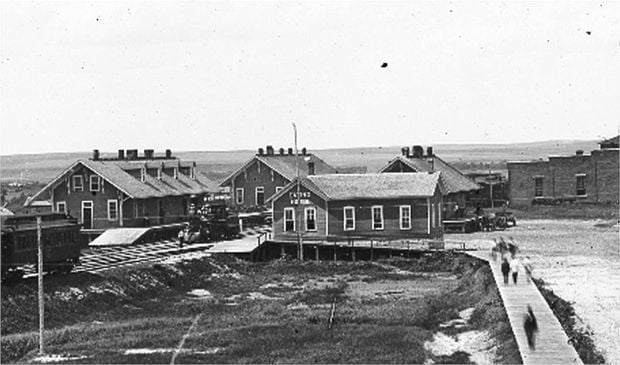
Lincoln's first depot was at about Fifth and Q streets in 1870. By 1880-81, rail traffic was heavy enough to justify construction of a three-story brick-and-stone structure at Seventh and P streets, which gave way to a new building in 1927 known today as Lincoln Station. BNSF still has offices on the upper floors. On June 25, 2012, Amtrak moved to its new depot on Arena Drive.
Lincoln would be served by all five of Nebraska's major railroads. Union Pacific, Missouri Pacific, Chicago & North Western and the Rock Island arrived between 1880 and 1890. The U.P. remains, with its tracks running from northwest to southwest Lincoln.
The Omaha, Lincoln and Beatrice Railway was launched in the early 1900s as a line bound for Omaha, but it only got as far as Bethany, plus a branch to University Place. It ran suburban passenger service from 14th and O streets to the two suburbs until May 1928. When it was on the verge of abandonment it was acquired by George P. Abel Sr. for freight switching and industrial development. It is a NEBCO Inc. subsidiary, known as the Big Red Line, and extends mainly northeast from 18th and Y streets.
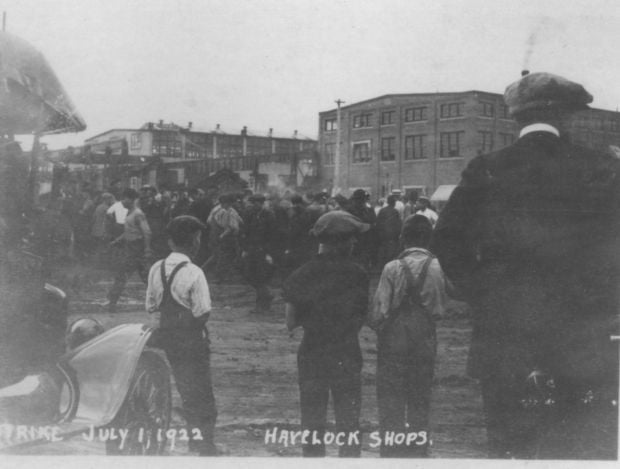
The Burlington opened locomotive repair shops at Havelock in 1891. Seventy steam locomotives were built there between 1895 and 1913, one of them being No. 710, now on display north of Lincoln Station. Havelock was converted to a freight car shop in 1931 and even closed for a time during the Depression. Construction of freight cars began in 1936, and by the time work shifted to outside contractors in the late 1960s, more than 55,000 freight cars, cabooses and baggage cars had been built there. Today, Havelock is the primary car shop for the BNSF system and also repairs and assembles wheel sets.
The Pioneer Zephyr began operation as the nation's first diesel-powered streamlined train in regular service on Nov. 11, 1934, making a daily round trip from Lincoln to Omaha and Kansas City, Missouri. It ended its career Feb. 20, 1960, and is now on display at the Museum of Science and Industry in Chicago.
Other Zephyrs followed, including the famous California Zephyr, inaugurated between Chicago and San Francisco in March 1949, with Vista-Dome cars and a schedule designed for scenic viewing. Amtrak, which has operated passenger service here since May 1, 1971, continues its version of the California Zephyr today. In the 12 months ending Sept. 30, 2014, Amtrak reported 13,313 boardings and alightings in Lincoln, up from 13,160 the previous fiscal year.
Special trains brought visitors to Lincoln for the State Fair and many other events. At least one football special usually ran from Omaha to Lincoln for Nebraska football home games, with five trains arriving here on Oct. 31, 1964, for the Missouri game. The public football specials ended after the 1975 season, but one was operated Sept. 20, 2014, for the Miami game.
In years past, presidents, presidential hopefuls and other notables passed through Lincoln by train. Among them, President Franklin D. Roosevelt arrived on Oct. 10, 1936, going by motorcade from the depot to the Capitol to speak. President Harry Truman spoke to a crowd of 10,000 in a driving rain from a temporary platform in front of the old Sullivan's warehouse northeast of the depot at 700 Q St. on May 8, 1950. Dwight D. Eisenhower stopped here on a CB&Q special on July 3, 1952, en route to the Republican National Convention in Chicago, where he would win the nomination.
The depot hosted royalty — briefly — on April 18, 1939, when Danish Crown Prince Frederik and Crown Princess Ingrid made a brief stop on a Burlington special train. The 3,000 gathered here barely got a glimpse of the royal couple, who appeared at the opened rear door, when the train began moving again unexpectedly. Several Danish groups planned to present a picture of the Nebraska Capitol, so a University of Nebraska student grabbed it and gave chase, throwing it at the rear door when he knew he couldn't catch up. The prince caught it. A special train carrying Queen Marie of Romania stopped here on Nov. 11, 1926.
Lincoln is far from subways or commuter trains, but the Kawasaki Motors Manufacturing USA plant on the city's northwest edge is a major supplier of cars for transit and commuter systems in New York City, Boston and Washington. Assembly of rail cars began in November 2001.


