




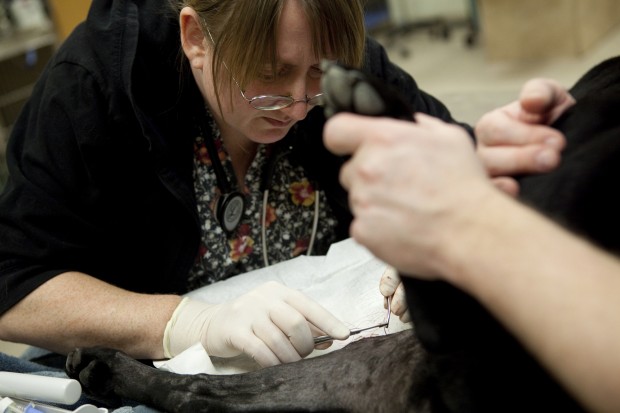
"It's one of those days where if it's coming out of one end, it's coming out of both ends," licensed veterinary technician Tonya Forbes says as she prepares to induce a 16-pound dog to vomit up the pound of chocolate it has just eaten.
Welcome to the pet ER.
Veterinary Emergency Services of Lincoln is open at 3700 S. Ninth St. when regular vets are not -- 6 p.m. to 7 a.m. Monday through Friday and noon Saturday to 7 a.m. Monday.
"On a personal level, the night shift is a nice shift," said Dr. Christine Carr, who has been with the practice for five years. "It means I can be home when I need to for driving to and from school and family things that need to be done."
And, she said, she likes how challenging the work is. Cases that come in at night are vastly different from those a vet might see during the day.
People are also reading…
"When we get busy, we get a lot of things that require a lot of thought," she said.
Every night is different, she said.
She does miss a few things about the day shift, she said, like the connection with owners and watching a pet grow from a puppy or kitten. Still, she feels some of that bond late at night.
"It is almost a deeper connection, in a sense," she said, "because it is the middle of the night and you're catching somebody in a vulnerable moment. It's definitely different interpersonal relations than we get during a day practice."
The connection between co-workers is deeper, too.
Hospital director Dr. Robin Dishman lovingly refers to her technicians as her kids. They talk about personal, financial, relationship and business problems or worries, she said. Nobody needs to use the terms "my kids" or "my husband" or "my ex," she said, because everybody knows everyone else's family by name.
"It's kind of like 3 a.m. at a slumber party thing, where you get to a different state of mind," vet technician Valerie Cooper said. "When you work this long of hours together, you get to be closer, you get to understand the people more."
But the vets who work the night shift see a lot of critical cases.
"When it's something you can fix, it makes you feel like you did a good thing," said Cooper, who has been on the night shift for several years and says she'd never go back.
"But we also get the flip side, too."
Like the dog whose lungs were filled with fluid.
Vet tech Kevin Bakenhus puts the wheezing dog on the X-ray table after pictures are taken.
"This is what they call drowning from the inside out," he said.
Ultimately, the dog's owners decided to have it euthanized. As the staff carefully placed the dog's body in a biodegradable coffin, Cooper stopped, then ran to a cabinet and came back with a towel to place beneath its head.
"I'm sorry, sweetheart," she said, stroking the dog's head.


