




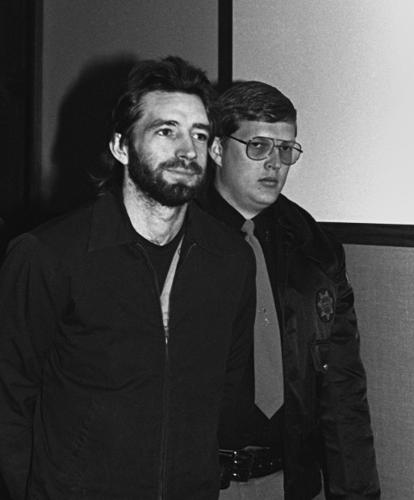

Joseph White thought one thing could prove him innocent of the 1985 rape and murder of Helen Wilson.
As he stood before the judge on Jan. 18, 1990, he asked for DNA tests, believing they would show he wasn't in the Beatrice widow's apartment.
At the time, DNA testing was still new to the courts. Three years earlier, it helped convict a Florida man of rape, a first in the United States.
Before long, defense lawyers realized it could also exclude a suspect - as it eventually would in White's case, undoing a extraordinary murder investigation and the convictions of six people. The case would come to be seen as the most egregious miscarriage of justice in Nebraska history and set a mark nationally for DNA exonerations and wrongful confessions.
But in 1990, Gage County Attorney Richard Smith believed he had the gold standard that proved White's guilt - a jury verdict. The righteousness of 12 people who heard the evidence, weighed it and delivered a just decision constituted the very foundation of the criminal justice system.
People are also reading…
That guilty verdict represented the culmination of hundreds of hours of investigatory work, reams of reports, dozens of court hearings. It brought some closure to Wilson's family, who, for years, had agonized the case wouldn't be solved.
As for DNA, Smith argued the FBI wouldn't even use the new technology on evidence obtained before 1988. Whatever biological samples were collected from Wilson's apartment in 1985 were surely degraded beyond use by the passage of time.
District Judge William Rist denied White's request.
Now nothing could prevent Lobo, 28, from spending the rest of his days in prison.
Except for possibly one thing, locked in the basement of the Beatrice Police Department.
As the years passed, everyone but Lobo would forget what was there.
The other sentences
In January 1990, the judge sentenced the last of the six to prison.
He gave 29-year-old Kathy Gonzalez 10 years for aiding and abetting second-degree murder, the same punishment James Dean and Debra Shelden received a few months before.
Next was 27-year-old JoAnn Taylor. She had pleaded guilty to second-degree murder and helped convict White with her testimony. In exchange, the prosecution agreed to recommend a 15-year sentence.
The judge ignored the recommendation. Because Taylor said she placed a pillow over the face of the 68-year-old victim, the judge believed she likely killed her.
He sentenced Taylor to 40 years in prison.
Finally came Tom Winslow, now 24. Before his sentencing, he insisted he had no recollection of being in the victim's apartment.
Winslow got 50 years for aiding and abetting second-degree murder.
Case closed.
The deputy's finest hour
Sheriff's investigators and the county attorney had put six people behind bars for a single murder.
But it was really Deputy Burt Searcey's case.
The former hog producer turned sheriff's investigator had taken a tip from a confidential informant and unraveled a crime some thought couldn't be solved.
The sheriff promoted him to lieutenant and put him in charge of investigations and road troops.
Helen Wilson's family considered him a hero. In his honor, they gave $3,000 to the sheriff's office for new firearms.
The City Council and Optimist Club recognized Searcey for a job well done. The Sunday Journal-Star published a profile story headlined, "Investigator's tenacity key to solving Beatrice murder."
"There is no more satisfaction than being able to go up to a victim of a violent crime or some other major crime and say, 'We arrested someone,'" Searcey said in the article.
But it came at a cost. Even before he began working full time on the case, his marriage was in trouble. The constant stress and long hours drove it past the breaking point.
Then, in 1993, Searcey resigned. He wasn't forced out, just burned out. It was time to do something different.
He bought a liquor store in Beatrice.
Keeping hope
The name Lobo didn't stick when Joseph White got to the Nebraska State Penitentiary.
"In prison, they called me Alabama. Or 'Bama. Or Al."
Early on, a couple of inmates messed with him. But he stood his ground and told them to take their best shot, because they wouldn't get another.
No one much bothered him after that.
His parents, living in Alabama, could afford to visit him only once a year. They stayed in touch through letters and calls.
He threw himself into work. His first job as a janitor paid $1.21 a day. But then he got on in the wood shop where he started at 38 cents an hour.
His goal: Save enough to hire an attorney.
It took seven years.
The first lawyer took the case nowhere. The second, just out of law school, did a lot of work, but never filed an appeal.
Then, in 2001, the Nebraska DNA Testing Act took effect. It allowed people convicted of felonies to file motions for DNA tests if the technology was unavailable at the time of their convictions.
White wrote to a law firm in Norfolk that he had heard was good at post-conviction appeals.
In 2005, senior partner Doug Stratton was at the prison for other legal work and decided to tell White face-to-face he wasn't going to take the case.
But after the meeting, Stratton changed his mind.
The Norfolk attorney began preparing a motion to obtain DNA testing. He interviewed some of White's co-defendants and realized Winslow also stood to benefit from DNA tests.
In October 2005, both men filed motions to have crime scene evidence tested. Winslow was represented by Jerry Soucie of the Nebraska Commission on Public Advocacy, a state agency that provides legal counsel to the indigent in serious felonies.
The attorneys obtained court orders to protect the evidence so it didn't suddenly turn up missing. It had been secured for 20 years in the police evidence vault in the station's basement.
"The way things were progressing in the criminal justice field, things that you couldn't get tested today could get tested tomorrow," said former Police Chief Don Luckeroth, explaining the policy years later.
Richard Smith, then Gage County attorney, argued against White's motion. And he said Winlsow had forfeited the right to challenge his conviction because he pleaded guilty.
On Aug. 28, 2006, a district judge denied both motions.
Essentially, the judge said a favorable result for White or Winslow would only suggest one or the other didn't rape Wilson. The men still could have participated in the crime in other ways.
They appealed to the Nebraska Supreme Court. The high court ruled in their favor on Nov. 2, 2007, more than 22 years after Helen Wilson was murdered.
The justices decided DNA testing might exclude both White and Winslow as sources of the semen. Such a result would have caused jurors at White's trial to seriously doubt the testimony of Taylor, Dean and Shelden.
Run the DNA tests, the Supreme Court said.
Nearly 18 years after his arrest, White had won a significant court ruling.
His hope grew stronger.
Freedom in the lab
In 2008, the Human DNA Identification Laboratory at the University of Nebraska Medical Center tested blood and semen samples recovered from the apartment.
Two cuttings from Helen Wilson's nightgown.
Two slides and a cutting from the carpet.
A slide of fluid taken from inside the victim.
They also tested blood from White, Winslow and Wilson.
Lab analysts used a method that required only tiny samples to extract DNA. The age of the sample mattered little, but it needed to be free of cross-contamination. In other words, if the police who collected the evidence contaminated it with their own cells, the tests wouldn't work.
The tests worked - and they excluded White and Winslow.
On Aug. 1, Stratton and Soucie announced what they called the first DNA exoneration in Nebraska.
But White and Winslow were still in prison. Their attorneys filed motions to vacate their convictions, but nothing happens quickly in the legal system.
The only other person still in prison was Taylor, who was just a year from her mandatory release from the minimum-security Omaha Community Correctional Center.
The ball was now in the court of Randy Ritnour, who had defeated Richard Smith for Gage County attorney in 2006. He sought help from Attorney General Jon Bruning, who assigned two state attorneys to the case.
The prosecution team soon realized much of the preserved evidence had not been tested. They got a court order to conduct DNA profiling on the remaining 40 or so biological samples from the crime scene.
"When we started this thing, we started with the intent of showing that these guys were there," Ritnour said. "We were looking to put all of them there."
The additional tests cleared White and Winslow. None of the semen, blood or pubic hairs found on or near the body could be linked to the men.
What's more, none of the crime scene DNA matched Taylor, Dean, Shelden or Gonzalez. It belonged solely to Helen Wilson and an unidentified male.
A judge ordered a new trial for White and released him on his own recognizance.
"It's been a long, hard road and I'm glad it's over," he said as he was led out of the courthouse on Oct. 15.
A few hours later, White walked out of prison a free man for the first time in 18 years and eight months. He checked into a Lincoln motel.
"Took a soak," he said. "Slept in a real bed."
He got to Omaha, where he visited a friend he made on the inside. Then he bought a plane ticket and flew to Alabama, to his parents, a brother and three sisters. One brother died while he was in prison.
"Well, I've never been real emotional about anything, but the relief and everything of finally getting this over with, just sitting back, I would tear up," he said. "Still, some things, I just start talking about some things, they just flow."
But one huge question remained.
If Joseph White and Thomas Winslow didn't rape and murder Helen Wilson, who did?
Reach Joe Duggan at 473-7239 or jduggan@journalstar.com.


