
He had no way of knowing then -- that spring, decades ago -- that his phone would ring when he was an older man.
And he would listen, hang up and scream, in disbelief and then in sorrow, at the top of his lungs. The father of the first Nebraskan killed in combat after Sept. 11, 2001.
But that was still so far off. That spring, Richard and Roseann Svitak were happy, hopeful -- another young couple launching their lives together in Lincoln.
They'd moved from their side-by-side hometowns of Howells and Dodge to a small rental near 38th and Garfield. He got work driving a delivery truck, she found a job at the downtown post office. They bought their groceries from the IGA on 48th Street.
But mostly, Richard and Roseann spent that spring waiting for their first child.
And waiting. Phil wasn't ready at nine months. He wasn't ready the next week. Or the next.
People are also reading…
"My wife carried him for 10 months," Richard says. "My wife couldn't have him."
Their doctor stopped waiting. He cut into Roseann and pulled Phil into this world -- a riskier move at the time -- and the infection almost stole her from the young family.
She healed. And she and Richard took their son home to Garfield Street at the start of a Nebraska summer.
This was 1970, long before that moment on Sept. 11, 2001, when the world would start learning a new vocabulary, a new geography, a new reality.
And even longer before the day Richard would get that phone call.
"We look at it this way: It took 10 months to make a hero. That's what we say anymore."
The WTC worker
Todd Schwendiman was working alone in the hedge-fund firm he managed with his father in 1 World Trade Center.
The Lincoln native and his half-dozen employees had moved into the office months earlier. Now, through his west-facing windows, the 1986 Southeast grad could look down on the Hudson, flowing 78 floors below.
"It was very common for us to see planes and helicopters flying below our office, which was a very different experience."
He often worked marathon hours, and it was well after midnight on Sept. 11, 2001, when he locked up and headed down.
The tower was quiet in the early morning.
It would fill with thousands of workers in just a few hours.
The air traveler
A passenger across the aisle noticed the fighter jet first, running parallel, keeping pace with the airliner.
Then the pilot of United Flight 95 navigated a series of banks and turns high above the country's midsection.
"And someone could see there were planes in front and back of us as well, and then the pilot came on and said there was a national emergency and we would be landing shortly."
Clarence Hahn had never been to Nebraska. The consultant from New York -- he lived four blocks from the north tower of the World Trade Center -- had boarded a plane in Newark that morning.
He was supposed to meet with a client in San Francisco.
But now he was standing in Lincoln.
The country had changed while he was in the air.
The day we lost our balance
And you?
What do you remember?
Probably not much about Sept. 10. (Huskers are getting ready for Rice. Mideast peace talks stall again. Morgan Stanley is accused of discriminating against women. President Bush lands in Florida for two days of school visits.)
Then that day. Seared.
Your phone rang. Or panic interrupted your radio. Or you had "Good Morning America" on, background noise, until you caught something in the reporter's voice.
You heard his words stumble, trying to frame what was happening high in the building above him.
So you drew closer. You saw, without fully realizing what you were seeing at the time, the gray blur of a second jet hurtling in from the corner of your TV screen toward the second building. There were lives on that plane, lives in that building, and then they were gone. You saw that.
The ABC reporter said: "Oh, my God."
The ground beneath your feet wasn't as solid as it had been a moment before. And that moment is important. We all share that moment, even if the moment is different for all of us. It separated the world we thought we knew from the history unfolding before our eyes.
It was hard to watch. Harder not to.
More reports. The Pentagon. A missing 757.
The White House? The Capitol?
Then the towers collapsed, and with them the distance between Lincoln and New York and Washington and Pennsylvania and, later, Kandahar and Mosul. We would soon know somebody who saw it, felt it, described it, survived it, perished in it.
All of our feelings -- shock, uncertainty, anxiety, grief, guilt -- knotted and unknotted in our guts and braided together to give us a nationwide vertigo.
We lost our balance in those 102 minutes.
It was enough to make us want to sit down. And it was enough to make us need to get up and get busy.
In the hours and days that followed: We flew our flags. We painted them on our garage doors. We painted them on our front yards. We changed the marquees outside bowling alleys, gas stations, salons -- we promised to stand united, to never forget. We bought bumper stickers.
We searched for the right words for young ears. We vowed to be nicer to each other, to not take anything for granted.
We lit candles and swayed with strangers. We prayed privately and we filled pews.
"We've observed the lowest form of human violence this day, but I pray our response as Christian people and people of many faiths won't lower us to the same standards," the Rev. Lauren Ekdahl told 125 worshippers at Trinity United Methodist.
We enlisted.
We got ready to shock and awe.
And, in the most basic human gesture, we opened our veins. Blood spilled, blood replenished.
"As the day unrolled, it was amazing. People just came streaming in, because that's how I think Nebraskans are," said Joyce Halverson of the Nebraska Community Blood Bank.
"The line went out the door and down the block."
Those who weren't giving blood were bringing cookies and juice for those who were. An appliance store delivered an extra refrigerator. Students from Elliott Elementary walked down O Street to give donors handmade thank-you cards.
The blood bank collected an additional 2,000 units that week and gathered the names of 5,000 would-be donors, an outpouring unmatched by anything before or after Sept. 11.
"We've had some emergencies, but nothing, nothing that compares. It was like that for the whole week."
It was like that until hope faded at ground zero. "Once we realized there was not going to be survivors and that large amounts of blood were not going to be needed, we cut back."
The morning of Sept. 11 is still fresh, a decade later. Halverson and her boss had been driving back from the mayor's office, talking about the need for donors.
Next door to the mayor's office, the police department's command staff gathered around a conference table for its weekly meeting. There would be the usual crime that day: 36 crashes; 26 thefts; 10 missing people; six child abuse reports.
And, of course, something bigger. A secretary interrupted. A plane had hit the World Trade Center.
"We scrambled to get the news on TV. About that time, the second plane hit," said Tom Casady, the city's public safety director and former police chief.
The chief sent officers to guard Lincoln's landmarks: the airport, the Capitol, both sides of the county-city building.
"We had no idea what was going on. But we had a strong suspicion we were under some kind of external attack. Was this a foreign power? Was it a Pearl Harbor-like attack that was launching a war? Was it an act of terrorism?"
The police presence served a dual purpose. Preparedness, in case further attacks threatened to hit closer to home. "And to be some sort of reassurance to the general public."
They found rides and rooms for the hundreds of travelers who landed, unexpectedly, in Nebraska, and whose memories of Sept. 11 will always be rooted here.
But the police department's work was just beginning.
Because we called the cops that day when we saw a suspicious car parked near the airport, and a blue van near 13th and Military, and a white van outside of Pfizer, a Middle Easterner in the driver's seat.
The calls would continue the next day, and the next year, and the next.
"It went on for a couple of years. Suspicious parcels and packages and lunchboxes and briefcases and all sorts of stuff."
But we didn't call just the cops that day. One of us went through the white pages, threatening those with Arabic last names, until one of them called the cops on us. And one of us shared hate and profanity with the Lincoln Islamic Foundation, hours after the attacks.
The chief and others would try to douse those flames at an early press conference. "The basic message was: This terrorist attack has nothing to do with people in Lincoln of Middle Eastern descent or people in Lincoln who were Islamic."
That night, the night of Sept. 11 -- after we hugged our kids and told everyone we loved that we loved them and vowed the terrorists wouldn't win -- so many of us fell asleep knowing we'd witnessed the end of something. Of thousands of lives, of course. And of our sense of normalcy.
But so many of us fell asleep not even knowing Sept. 11 was a beginning, and real pain would come later.
The air traveler
Clarence Hahn and a colleague worked late Monday night, preparing to meet with a client in San Francisco the next day.
They finished at 3 a.m. They thought, fleetingly, about catching some sleep and leaving a little later than planned.
But they departed Newark at 7 a.m. on United Flight 95.
The next plane -- the one they'd thought about taking -- was United Flight 93.
"That's the one that went under," Hahn says. "My wife didn't remember which flight I was on."
The fighter jet outside their window was the first sign. Cool, he thought at the time, but then troubling. Their plane started banking and turning, clearing the airspace above Omaha, where President Bush was headed.
The pilot's message was short and vague. There had been a national emergency, and they were landing.
"Everyone was trying to figure out what was going on." Their best guess: a massive earthquake in San Francisco.
They didn't learn what had happened until a passenger pulled out a small radio as they were taxiing to the terminal.
Hahn's first impression of Lincoln? "It was a funny sight. All these big planes and a small airport."
At that moment, though, he was worried. His home -- his wife, their three sons -- were less than 1,000 feet from the World Trade Center. He couldn't get close to the TV in the airport lounge. He sat down, switched on his pocket TV and soon had a crowd of 40 or so trying to see the 2-inch screen over his shoulder.
There, in a strange city, he watched his neighborhood burn and crumble. He felt as though he were in a movie. He finally reached his family. They were safe; his wife and children ran from the schoolyard when the plane hit.
"My whole time in Lincoln was one of massive apprehension and anxiety, and then massive relief."
And then a need to get home. A cab driver drove Hahn and his colleague to The Cornhusker. He wanted to charter a plane, hire a helicopter, but the skies were ordered empty.
He couldn't find a rental car.
He asked the concierge: Do you guys have weddings here? Do you have a limo service?
Within hours of landing in Lincoln, Hahn and his colleague paid $1,200 for a ride to Chicago in the back of a limo. He borrowed a friend's car for the rest of the trip but found traffic backed up in Pennsylvania because the bridges to New York remained closed.
He didn't get home until that Thursday.
That was 10 years ago. His memories are clear. Hahn moved his family from New York to suburban Washington, but returns to the city several times a year.
"It feels like there's a hole in the skyline."
The WTC worker
Funny things happened on the way to the 78th floor on Sept. 11.
One employee got to work at Todd Schwendiman's office at 8:15 but forgot her security badge. She had to wait in the World Trade Center lobby until 9 -- the earliest she could be issued a temporary pass.
Another employee always reported to work at 7:30. Clockwork. Except that day -- he had to drive his kids to school because his wife had been in a fender-bender the day before.
"There are all these wild stories about why people weren't in the office," said Schwendiman, the Southeast grad.
The result: The offices of Schwendiman Partners LLC were empty when the plane hit that morning.
And Schwendiman was home, too, after working so late but waking up to his phone.
"My sister called me to say, something happened to your building."
He reached all of his employees, realized they were safe. Then he called in to change his office voicemail, telling clients the firm would be temporarily displaced.
The towers were still burning, but he never expected them to collapse.
"We thought that there was going to be a fire, they'd get the fire out and there would be damage."
A couple of days later, as he watched the head of Cantor Fitzgerald talk about how many people that company had lost, Schwendiman cried for the first time. It could have been him, talking about the staff he lost.
"That's when things really hit me and sunk in."
A friend who ran a Turkish brokerage firm let Schwendiman and his staff crash in his boardroom for a few months. But the company never recovered from the attacks, and it was closed within a year.
The parents, their pain
The 10-month baby grew into a little boy, and then into a soldier, choking up over the phone to his father on Sept. 11, 2001.
Richard Svitak had watched the second plane hit while at the Home Depot in Joplin, Mo.
"And Phil, he was crying. When he saw what those people were doing to our people, it just broke his heart."
What his son said next didn't surprise Richard: "We'll be saddling up and getting ready to take them on."
Richard and Roseann hadn't stayed on Garfield Street for long. In 1976, they moved Phil to a big house outside of Fremont, near the Elkhorn River. He grew up riding his bicycle, grew into a desire to wear olive-drab green and serve his country. He had joined the Army even before he graduated from Fremont High in 1989.
"We talked about the military. We didn't make enough money for him to get schooling and stuff."
Phil didn't want to join the Navy, stuck on a ship far from action. He turned, instead, toward the 160th Special Operations Aviation Regiment -- a chopper group known as the Night Stalkers for carrying out its missions in darkness.
"After he found out about the 160th, what they did and everything, that's what he wanted to get into. With the Chinook helicopter doing all sorts of crazy things, that's what he wanted to do."
He served from 1989 to 1994, when he moved to the Joplin, Mo., area, where Richard had found a job driving a FedEx route. Phil got a job driving for a lumberyard until Richard helped him buy a FedEx route into Oklahoma.
Phil met a woman at work, Laura, a supervisor. They married, had two sons, Ethan and Nolan.
But there was something missing, something an ex-soldier-only-child couldn't find behind the wheel of a delivery truck. "He missed his brothers. All those guys were his brothers."
He rejoined the Army in 1998, forced to start over but happy to be back.
Richard and Roseann saw their son at Thanksgiving 2001. The U.S. had invaded Afghanistan the month before.
"I knew he was going. That was part of the job."
Richard's phone rang a few months later. His daughter-in-law. And what she told him ended the story that started in 1970, in a little house on Garfield Street, about a little boy with his life ahead of him.
"Worst day of my life," the father says. "It's like somebody pulled your heart right out of your chest."
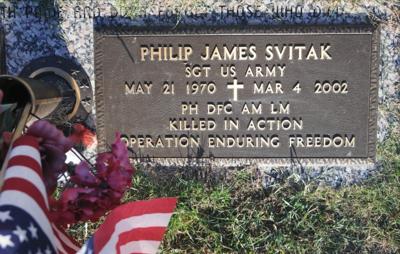
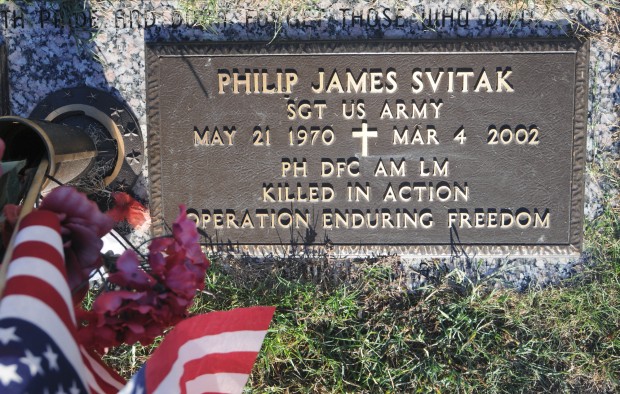
On March 4, 2002, Phil's job took him to a remote mountaintop in eastern Afghanistan, part of Operation Anaconda.
A pair of choppers dropping off Navy SEALS had been attacked, and a SEAL had been left behind. Phil was part of a rescue mission that flew into the same enemy fire.
Phil was firing a minigun out the right door as the pilot struggled to land the crippled Chinook. Phil fired it so hard the hot metal burned his arm. He was calling out targets -- "one-o'clock, three-o'clock, engaging," the pilot told "Dateline NBC."
The pilot told Richard his son died a hero.
"If it wasn't for Phil taking out a bunch of enemy on the ground when they crash-landed, they probably would have been overrun."
Sgt. Phil Svitak was among seven U.S. soldiers killed in the fight.
His parents have always drawn a short, straight line between that sunny Tuesday morning in September and the day their son was killed on a snow-covered ridge so far from Garfield Street.
In May, they broke open a bottle of wine. "We toasted to Phil that we finally got him. His brothers finally got bin Laden."
And last month -- the deadliest month for the U.S. military since it invaded Afghanistan -- they hosted the 10th annual Svitak Freedom Ride, a charity bike ride to raise money to buy bikes for military children.
The event is always bittersweet, but it was tempered this year by the early August crash of a Chinook chopper, like Phil's. Thirty more Americans died that day.
"It broke my heart when that helicopter was shot down, because those were Phil's brothers."
Reach Peter Salter at 402-473-7254 or psalter@journalstar.com.
Peter Salter
General assignment reporter