


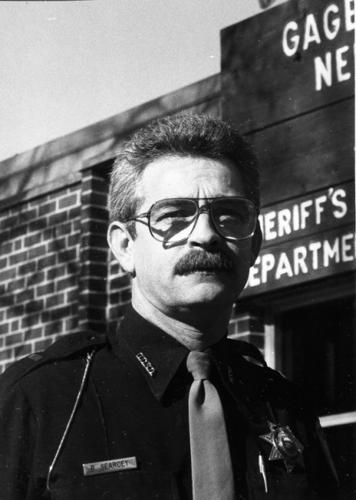
Understanding how Nebraska law enforcement authorities accused six people of a crime they didn't commit starts with understanding how the lead investigator locked in on his top suspect.
Gage County Sheriff's Deputy Burdette "Burt" Searcey headed the official investigation, but in 1985, he started working the case as a private detective. Two months after the crime, a confidential informant told Searcey the widow was murdered by a guy called "Lobo," whose real name was Joseph White.
Searcey's faith in that 17-year-old girl led to a chain of events that ended with murder convictions of Lobo and five others.
But records show Searcey likely overlooked or ignored evidence of White's innocence.
Here's one example:
By the time Searcey joined the sheriff's office in 1989, he was convinced White was behind the attempted sexual assaults on three elderly Beatrice women in 1983, almost two years before Wilson was killed. Searcey, along with other investigators, thought those unsolved attacks were the work of the widow's killer.
People are also reading…
One of Searcey's reports says he believed White was living in Beatrice during the attempted assaults. During interrogations of other suspects in the Wilson case, the deputy tried to establish that White must have been the stalker of elderly women.
Except White could not have been in Beatrice in 1983. Military records show he was in the Army, serving in South Korea until early 1983 and at Fort Hood, Texas, until May 1984.
In 2008, a member of a task force that reopened the Wilson case talked to Searcey and found out he still thought White perpetrated the 1983 attacks.
That flabbergasted Assistant Attorney General Corey O'Brien, one of the task force leaders. To him, it seemed as if Searcey was consumed with pinning the murder on Lobo.
"The whole plan the whole time was to go after Joe White," O'Brien said later in an interview. "Burt said he knew beyond a shadow of a doubt it was Joe White."
There are more examples of Searcey's confidence in Lobo's guilt.
In an interview with the Journal Star, the deputy said he knew little about forensic evidence gathered from the apartment, which contrasts with established police procedure. Most homicide investigators pore over the crime scene not only to discern what happened, but also to rule out what didn't.
The Wilson crime scene revealed the work of a single, sexual predator - Beatrice police investigators and an FBI profiler thought so, as did the sheriff's own forensic psychologist.
Yet Searcey built his investigation not on crime scene evidence but on participant testimony. To him, Wilson's death was the work of a group led by Lobo.
Still, he obsessed about one thing found in the apartment - a torn $5 bill. The confidential informant told him White routinely performed a trick that ended by tearing apart a bill.
As interrogation videos and sheriff's reports show, Searcey tried hard to link the torn bill to White.
For instance, he repeatedly asked JoAnn Taylor whether she ever saw Lobo do a money "trick." The best she could come up with: liar's poker -a bar game using the serial numbers on dollar bills.
So the deputy asked Taylor more specifically.
"Did you ever see him do anything that might result in destruction of money?"
"Hmmhmm," she replied.
"What would he do? What would he do?" Searcey wanted to know.
"He would tear it up."
A little later, Searcey asked whether she ever saw White pocket the torn money after doing the trick. When she said she had, Beatrice Police Sgt. Sam Stevens stepped in.
"JoAnn, you seen him that night, you seen Lobo take a $5 bill out of that purse that night?" Stevens asked.
"Hmmhmm."
"And you seen him throw it on the ground?"
"Yeah, he did, yeah."
"What happened to the other half of that $5 bill?"
"He stuck it in his pocket."
Searcey told the Journal Star he still is convinced White and the others had something to do with Wilson's death. In other words, DNA testing has simply implicated a seventh person, in Searcey's view.
The task force made him a scapegoat, the deputy said.
In his defense, he insisted the informant knew things about the crime scene that hadn't been publicly released. An example: an overturned footstool found near Wilson's body.
But according to a story published by the Beatrice Daily Sun, the police chief mentioned the footstool at a news conference the day after the murder - two months before the informant would give her account.
Searcey countered that his informant knew the stool was covered in green vinyl - details not included in the story.
The Journal Star's attempts to clarify the point proved difficult because, while a private investigator, Searcey made no recordings or written reports from his 1985 encounters with the informant. His first report about what she said wasn't written until 1989, four years after Wilson was murdered.
The informant did not respond to the newspaper's request for an interview.
Nonetheless, Searcey maintained he did nothing wrong. He described himself as a fact-finder who adhered to a high standard of proof.
Taped interrogations do show him challenging several suspects about the truth of their stories. At other times, he asks point blank if he told them what to say when the camera was off.
They always responded, "No."
Those who see conspiracy in the convictions of the six should consider a more obvious explanation, he said.
"These people told us this information," Searcey said.


