
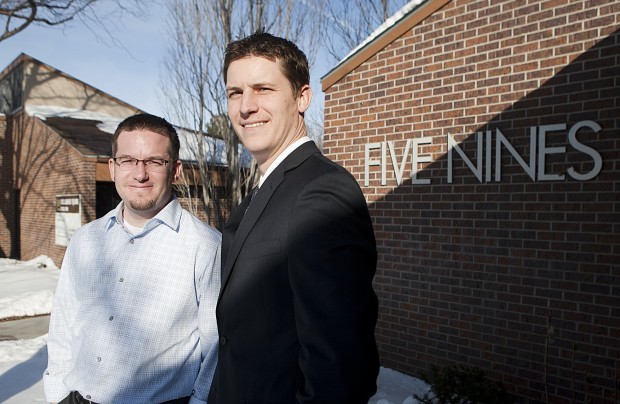
It's not easy to spot something out of place at Five Nines Technology Group.
Maybe a sense of order and attention to detail are inseparable from a name meant to convey the 99.999 percent standard of reliability for a computer operating system.
At any rate, the covers of copies of Network World magazine are arranged at the perfect, readable angle on end tables in the lobby at the Lincolnshire complex at 1560 S. 70th St.
The awards on the walls, including "Entrepreneurial Superstars" recognition of one of the fastest growing companies in the United States in 2009, show not the slightest lean to the left or right.
Could that hammer on the windowsill in Nick Bock's office be a hint of the disarray seen in other offices or the frustration others experience with electronic circuits?
People are also reading…
Nope. It turns out one of the founding partners in Five Nines was just using it -- in his spare moments -- to drive the nails that will allow him to hang personal mementos.
There haven't been a lot of those spare moments for Bock, 35, and James Bowen, 32, as they form more of the resource relationships they covet with companies in the digital world.
"I see us continuing to grow at the same pace or at a faster pace than we are right now," Bock said.
Five Nines, a provider of managed services, IT services and consulting, grew from three people to 10 in 2007, from 10 to 17 in 2008, from 17 to 23 in 2009 and from 23 to 37 last year.
Demand for services outgrew their 2,000 square feet at 6710 L St. about 18 months ago. Now they're at 6,500 square feet and expanding into an adjoining building.
An Omaha office opened in 2009, and in early 2011, the search is on for two more employees there and two more in Lincoln.
Many of the customers are in Lincoln, but others are as far away as McCook, Wichita and Sioux Falls.
"We're almost 40 people now," Bowen said, "and that's beyond my wildest dreams when we started this thing."
Five Nines is not a vendor of services; it's a partner in sharpening the technology vision of clients managing law practices, for example, or medical clinics, restaurants and apartment buildings.
Patrick Ganyo, administrator at the Lincoln Orthopaedic Center, 6900 A St., is among those satisfied with the results.
Ganyo wants his work force of 84 to concentrate on hips, knees, spines and other troublesome body parts, not hardware and software.
Five Nines took over what had been assigned to two full-time staff people in late 2006 and early 2007.
"It's been a great move for us," Ganyo said. "We consider them part of our growth and evolution as an organization, as opposed to a vendor-client relationship."
It's a much better experience than discovering the person on the other end of a long-distance call for technical help is in another country.
"It's a Nebraska company with Nebraska folks," Ganyo said, "so we do not have that issue."
n n n n
On-going accolades are another way to judge that Five Nines is offering something that works.
Among those bestowing them from near and far are Inc. Magazine, the Lincoln Chamber of Commerce, and, in the past year, the Omaha office of the Small Business Administration.
The SBA's Michael Foutch called Five Nines "a pretty easy choice" for 2010.
"They've retained 95 percent of their clients," he said, elaborating on Nebraska's most recent Small Business of the Year. "And the reason they've been able to do that was their fantastic growth and dedication to their work."
Cloud computing, which allows Five Nines customers to use its centralized computer capacity rather than their own, is another plus, Foutch said.
"Spending all this money on big server rooms -- you've got to have power to do that. You've got to have dedicated IT (information technology) people. Really, it's not cost-effective."
n n n
Preserving momentum in the technology sector in a recession and in one of the nation's most rural states might seem implausible.
Many parts of the private sector are reputed to be in "wait-and-see" mode, and Nebraska has been given the "brain drain" label -- exodus of the best and brightest young people toward the coasts.
Bock and Bowen don't see a brain drain of epic proportions.
"I think the concept of bright young people leaving Lincoln and Omaha is somewhat overstated," Bock said.
Even when they do leave, that doesn't mean they'll never be back, Bowen said.
"It's amazing how many have left for a while and found a way back to Lincoln and to Nebraska. It's a special place."
Some of those finding their way back home might be coming because the future elsewhere has turned sour.
"We've not had the challenges that some of the other businesses on the coasts have had," Bowen said.
In fact, the Center for Public Affairs Research at the University of Nebraska at Omaha suggests the state may be experiencing a brain gain as the economy struggles nationwide.
Last year, Nebraska gained 1,600 bachelor's degrees, research coordinator David Drozd said. That's after losing more than 1,000 as recently as 2006.
"We have benefited from the economy here holding up relatively well and the economy being relatively poor in other places," Drozd said.
He sees it as a reverse brain drain.
"For right now, we're pulling out a lot of folks from Missouri and Illinois, where unemployment is basically double what ours is."
As the leaders of a relatively new business, Bock and Bowen have been able to recruit from the ranks of people they knew with backgrounds as network engineers and systems administrators.
They themselves initially met as people who liked Lincoln, considered family an important priority, and as competitors for a medical account at Bowen Consulting and Nebraska IT.
"We ended up meeting because Nick won some business from me," Bowen said.
Bock's responsibilities include presiding over sales effort and organizationaal structure. Bowen always has been more interested in such areas as computer programming.
Hiring people with the right credentials for jobs at Five Nines -- often involving eight to 10 years of experience -- is getting harder now, Bock acknowledged. But at least as big a key to continuing success is in hanging onto the people already on the payroll.
n n n
In the middle of the work day, the foosball table at Five Nines is getting a workout from two employees on break as others attend to high-tech challenges in the same room.
"It's critical that we keep staff here," Bock said. "Retention is the biggest thing because it takes a quarter of the energy to retain somebody as opposed to going out and finding somebody new."
There's also a ping-pong table and, out on the back porch, a barbecue grill.
Having a recreational presence in a business setting should not be taken to mean the pressures of work build to the point where the workers, many of them in their 20s and 30s, need emotional release. It's more about preventing work from becoming a grind.
"We want to create a culture of people who enjoy what they do," Bock said, "who are passionate about what they do and have fun.
"We have a number of people who are here before 8 o'clock. And a lot of people over their noon hour might play video games with each other or foosball or ping-pong."
Retaining people is also part of the business model that calls for on-going relationships, as opposed to vendor-type service and the sales staff cold-calling potential new clients.
In building relationships between customers and the green, blue and black teams, "we want them to know that Eric (for example) is their primary engineer," Bock said. "And, if they have a problem, they can call Eric."
Despite all the positive attention Five Nines has achieved, Bowen isn't going to attribute it to skill alone. The advantage of timing, for example, often is more apparent after the fact than before.
"Nick and I are a couple of very, very lucky people."