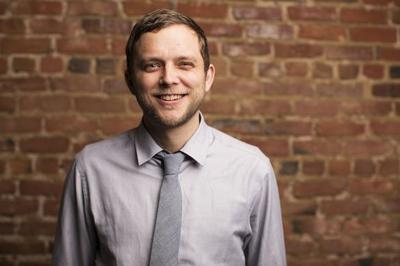

Andrew Norman never envisioned coming back to Nebraska. He left Imperial for college in Lincoln -- and then worked in Omaha before leaving the state for various opportunities.
What he quickly learned was the grass — when you can find a patch — isn’t always greener on the coasts.
“I never planned on moving back,” he said. “When you grow up here, especially in a small town, you feel like you have to leave.”
In his return, he discovered the Good Life is pretty good, while finding a passion to assist those in search of that good life.
In 2018, Rabble Mill, which is overseen by Norman and Mike Smith — another Imperial native — became the nonprofit umbrella for The Bay and Hear Nebraska. It’s an organization committed to giving Lincoln’s youth a place where they can grow physically and emotionally.
People are also reading…
Norman sat down with us at The Bay, the state’s only indoor skateboarding park, to talk about his career journey.
Tell us about Rabble Mill and its purpose.
Our mission is to provide economically and culturally disadvantaged youth with a belonging and purpose they need to grow and reinvest in their community. That’s kind of a larger mission. Really, we work to cultivate communities through subcultures — skateboarding, music and digital art.
We really focus on kids who identify as misfits, one way or another. Whether they’re skateboarders or musicians or coders, we’re here for them. These are kids that maybe aren’t as interested in traditional athletics.
Our goal is to use skateboarding and music as essentially a hook to teach kids interrelated digital skills that are directly related. Maybe it’s shooting a skateboarding video, content production, editing, audio. Those skills transcend any industry. This state needs content creators.
Did you consider yourself a misfit?
I was a kid who grew up in a divorced family. My parents each lived in a trailer park so I was kind of a double trailer park kid. Imperial is a small town in western Nebraska. I always felt like a misfit. I grew up seeking culture.
My hot button is just providing a place for kids to do the thing that they think is cool, whatever that is.
Kids come in here and they learn animation. They learn coding. They draw. They produce a for-youth, by-youth culture magazine. We do journalism through here. My hot button is really just giving kids an opportunity to use their voices and to find something that they love.
What’s the annual budget?
Our budget has been growing every year. This year, our budget is $1.4 million. Last year, it was $1 million. Three years ago, it was about $500,000.
We get money through the juvenile justice preventative fund; that’s our state funding. Our pie is about two-thirds individuals and grant foundations and one-third earned through program revenue — skateboard revenue, coffee.
How many people frequent this facility?
You can come in here one day, and there might be 10 people when school is in session or there might be 200 after school. If our coffeehouse is filled and we have skaters or a show going on in our concert venue, this place can easily have 200 people.
Is there a rule of getting their homework done first?
No, that’s not what we do. We work to build relationships. Our goal at The Bay is to create significant moments of impact for young people. That requires building relationships that allow us to identify even what a significant moment of impact for a specific kid is.
It might be the first time a young woman wins a skate contest and gets to visit Chicago to skate in the next round. We sent a group of kids to Los Angeles on a skate trip this summer. Most of them had never been on a plane before. That’s a significant moment of impact.
We had a young man who walked into a staff meeting one day and said, ‘I just got off the phone with my dad. I never met my dad before.’ Our director of skateboarding stood up and said, ‘I never met my dad, either. Let’s go talk.’ That’s a significant moment of impact.
There are programs where you have to get your schoolwork done in order to go play basketball. We feel it’s really critical to build relationships first. That’s what we work to do. Our goal is to help them find a path, to find their passion — to help build a relationship and the skills to make that a career.

Andrew Norman is the co-founder and chief operating officer of Rabble Mill.
Reach the writer at 402-473-7391 or psangimino@journalstar.com.
On Twitter @psangimino

Pat Sangimino
Business Reporter