



His first cup of coffee was filled with Butter-Nut, his mother’s favorite, softened and sweetened with milk and sugar.
Jason Anderson was just a boy in Kearney at the time, and that coffee didn’t change his life. He became a regular coffee drinker in college, but none of that changed his life, either.
Then, more than a decade ago, he bought a heat gun at a hardware store, the kind used to strip paint. He bought a steel sieve, and a spoon. He spent hours online, reading message boards and discussion forums.
Outside, on his patio, he poured a small pile of green coffee beans into the sieve. He aimed the heat gun with one hand, stirred with the other.
And he started roasting the coffee that would, ultimately, change his life, and his future wife’s, and those of the 25 to 30 people in Lincoln who would come to work for them.
People are also reading…
* * *
Anderson thought he would become a biologist, but changed his mind after taking college classes in Kearney.
He bounced around after that, living in Curtis, at Johnson Lake and then ending up back in Kearney, this time as an English major. He got to Lincoln in the late 1990s and worked for several years at the Journal Star as a newsroom clerk and computer tech.
He’d met Sharon Grossman at college and found her again when she moved to Lincoln, too. She wasn’t much of a coffee drinker then.
“I liked everything with milk and sugar,” she said. “Baby coffee, they call it.”
They were talking about starting a business, a food truck, when they heard about the Mud truck in New York. The idea of a coffee truck made sense, so in 2003 they bought a used FedEx van and installed an espresso machine.
At first, Anderson was buying and brewing coffee from a friend. But then he decided to supply his own, and he started experimenting with the temperature, the airflow, the agitation.
“When I started roasting on my own, it was the flavor of it, being able to control it -- that’s what got me hooked.”
After he outgrew the heat gun, he retrofitted a propane grill with an acetylene regulator that produced 8-inch flames. He built a motor-driven drum, like an enclosed rotisserie, to keep the beans moving in the heat.
He built a website, too, and started selling his coffee online.
The truck was a failure. They couldn’t make money. They couldn’t park and pour in high-traffic areas.
So he opened a store in University Place, just north of the used bookstore on 48th Street. Plenty of traffic there -- thousands of cars daily, passing a sidewalk’s width from Emergency Coffee’s door.
But they weren’t stopping. Parking was a problem. And he wasn’t catching a big enough crowd from Nebraska Wesleyan.
“We were breaking even at best,” he said. “We reached a point in 2011 that we about started packing it in.”
They wanted to move somewhere warmer. They were talking seriously about Albuquerque.
Then they heard another local roaster was interested in selling his shop. Cultiva Coffee had started small on South Street -- about the time Anderson moved into his space on 48th -- and had expanded to a bigger store on South 11th, a few blocks from downtown.
“We looked at his sales and we looked at the location,” Grossman said. “And there was a lot of potential.”
They didn’t qualify for a loan, so Grossman cashed out her 401k and quit her job.
* * *
Learning to roast coffee, to control all of the variables, took time. Learning to make a perfect cappuccino, with just the right texture to the milk, took practice.
But Anderson and Grossman became bosses overnight.
“Adjusting to running this place was harder on some levels,” Anderson said. “It’s emotionally more difficult, for sure, learning how to manage people.”
The change was difficult on some of Cultiva’s existing staff, Grossman said.
“It was hard to get them to come around on certain things they’d been doing a certain way,” she said.
But they made changes. On vacation, Anderson and Grossman had always sought out obscure eateries and food trucks, and they decided to replace Cultiva’s burritos with the kind of crepes they found in San Francisco and Portland.
They changed the shop’s name, to Cultiva Espresso and Crepes.
More importantly, they changed the shop’s culture, and its structure. They updated employee handbooks. They gave their staff clearer roles. They raised expectations -- and wages.
They pay better than minimum, and they gave everyone raises when Nebraska’s higher wage took effect in January.
“We’re trying to be a living-wage employer,” Grossman said.
Their business has grown by about 35 percent each of the past two years, Anderson said.
They appointed a head cook, kitchen manager, lead barista, store manager. Early on, they hired Tom Ailor as director of coffees.
He was an accounting student at the University of Nebraska-Lincoln when he took a job at the Starbucks near SouthPointe. He got pulled into the vibrancy of a coffee shop, and then he got pulled into the coffee.
“At some point, I realized -- accounting, I was good at it, but it wasn’t my passion.”
He quit college before his senior year and took an internship with a roaster in Indiana. On his first day, he was led through a coffee tasting. He was skeptical. He could never distinguish subtle flavors at Starbucks.
“I took a sip of coffee and it was eye-opening. I could taste the lemon. I could taste the citrus.”
Ailor's role as de facto general manager has taken pressure off Anderson and Grossman. They don’t have to be making crepes in the kitchen or preparing drinks behind the counter.
“It’s healthy for the business that they’re not here dealing with the day-to-day issues,” Ailor said.
More time for them to think about a bigger picture. Like a new store.
* * *
Anderson was driving down Holdrege Street last year when he saw a new building going up next to the old Valentino’s.
He parked in the back and looked in the window.
“Then I looked over at East Campus and I was, ‘Wow.’”
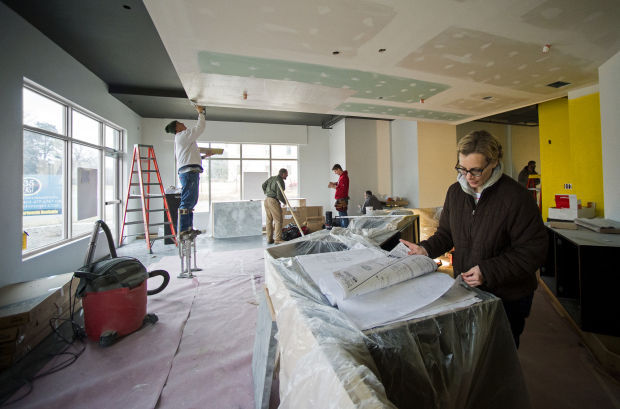
Thousands of students across the street made this a natural spot for a second site. They qualified for a loan this time and were able to design a 2,000-square-foot store from such a blank slate it still had a dirt floor.
This was new to them, negotiating a lease, working with architects and contractors, ordering equipment, training a new staff, solving problems, trying to stay on schedule.
“Many times, I’ve wished I was still roasting with a heat gun,” Anderson said.
But the second site is close to opening. If they build a third, they’ll know what to do.
They’ve had to learn that as business owners.
“Running a business is a methodical step at a time,” Anderson said. “There’s always something to tackle. Hopefully, things always get better.”
Reach the writer at 402-473-7254 or psalter@journalstar.com.
On Twitter @LJSPeterSalter.

Peter Salter
General assignment reporter


