

It started in the Husker training room, where Doak Ostergard wrapped thousands of ankles over the 20 years that he served as head football trainer, then head athletic trainer for University of Nebraska sports.
It continued in Ostergard’s home following his 2007 retirement as he searched out material and worked to design the perfect ankle brace — a lightweight device that would support and stabilize the joint but allow it to move.

Ostergard
More than a decade later, IFAST and XFAST — a pair of braces that are being made for, marketed and sold by the Lincoln startup ARYSE, in partnership with Ostergard — are being sold to individuals, as well as high school and college teams.
There's a market, simply based on the numbers. Estimates are that 25% of athletes sprain an ankle at some point, and of those who do, 40% are likely to reinjure that ankle, often multiple times.
People are also reading…
The old-school method of ankle support involved lots of tape, either to prevent injury or stabilize the ankle after it had been injured. That tape works to hold the ankle in place but often is so restrictive that it inhibits performance.
“We’re trying to change the whole thinking of ankle protection,” Ostergard said. "How do you have movement and still get protection? I think that’s what we’ve solved with these (braces).”

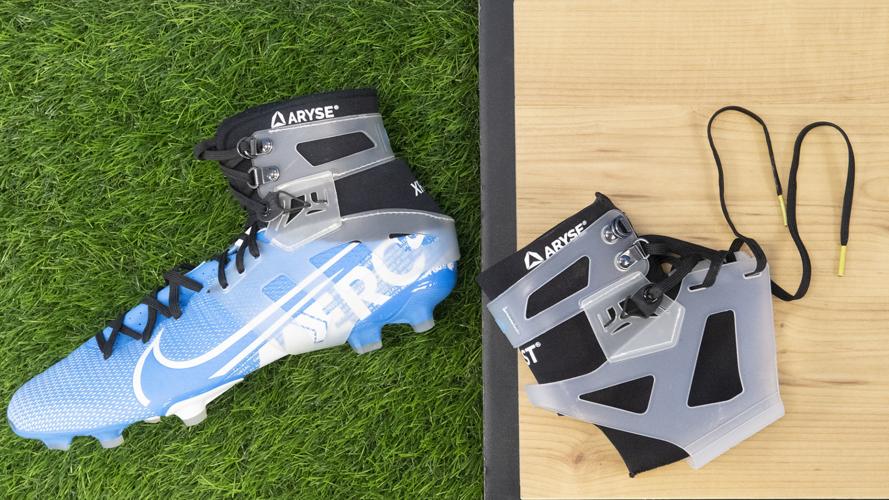
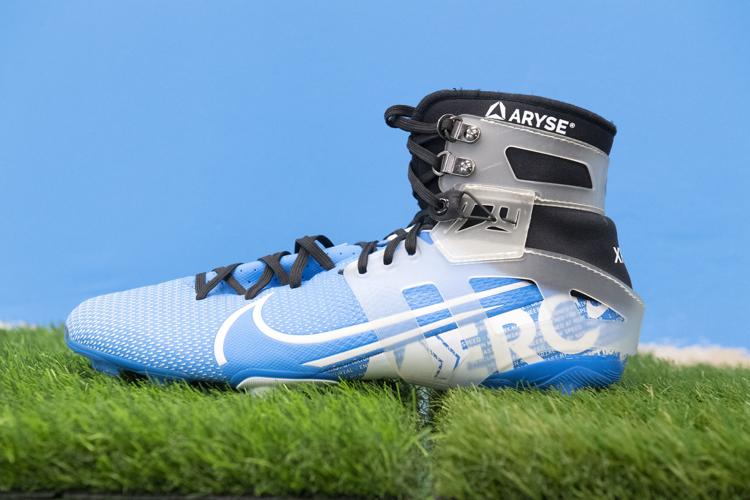
ARYSE developed the XFAST (left), an over-the-cleat ankle support, and IFAST, an inside-the-shoe ankle brace.
The IFAST brace is designed to be worn inside a shoe for hard-court sports — basketball, volleyball and tennis; the XFAST, worn over the shoe, for cleated sports — football and soccer.
The brace design has its Husker roots, but not on the ankle.
“Back in the training room days, we had issues with shoulder stability,” Ostergard said. “We tinkered around and came up with a shoulder device we called the Sully, after (head trainer George) Sullivan, that stabilizes the shoulder without restricting movement.”
That led Ostergard to seek a brace that would do the same for ankles, eliminating tape jobs that athletes dislike for multiple reasons and allowing greater movement of the joint.
A trial-and-error process led to the use of polyurethane in the plastic brace — “it best mimics ligaments,” said Alexander Carlson, ARYSE’s vice president of sales and marketing. The brace wraps around the ankle and under the foot or shoe and is snugly fitted with straps and strings.

Carlson
Testing has shown that the braces work as intended, providing “dynamic functional stability” — protecting the ankle while allowing the athlete to function at the level they were performing before their injury and wearing the brace, Carlson said.
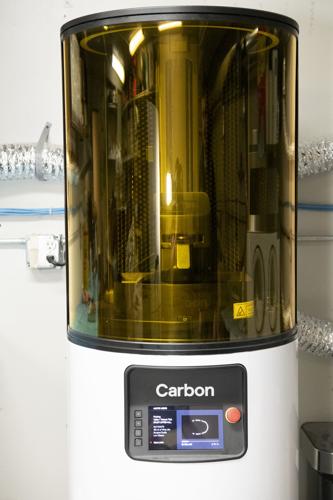
A third ARYSE brace, RFAST, is about to come on the market. Designed for those who suffer from chronic ankle instability or are recovering from a severe injury, the rigid-plastic brace is custom-made using 3D modeling, then created on a 3D printer.

ARYSE uses a 3D printer to make its RFAST brace designed for those who suffer from chronic ankle instability or are recovering from a severe injury.
The IFAST and XFAST braces are manufactured in Asia and may soon be made in Mexico, Carlson said. The company also has some operations in Utah and South Carolina.
The finished products are shipped to Lincoln for assembly.
ARYSE is shipping about 1,500 products a day out of its west Lincoln warehouse, Carlson said. Some, especially medical braces, are shipped in bulk orders. There are also direct sales to colleges, from NCAA Division I teams to NAIA schools. Individual orders are also accepted.
The braces sell for $49 — “We want it to be a quality product that is reasonably priced,” Carlson said.
ARYSE is working with athletes from multiple sports to get them to wear the braces and endorse them, raising the company's visibility and driving sales.
“We want to put an IFAST and XFAST on every athlete in the world,” Carlson said.
“Alex has lofty goals,” Ostergard quipped.
ARYSE also believes it can outfit military members with IFAST braces, including paratroopers, who are prone to ankle injuries, Carlson said.
ARYSE, which opened its doors in March 2016, also turns out walking boots, night splints, elbow sleeves and post-operative elbow braces.
But Carlson said the company intends to push its athletic braces, starting with the IFAST and XFAST.
“We have no intention to stop anytime soon,” Carlson said.
Reach the writer at 402-473-7244 or kwolgamott@journalstar.com.
On Twitter @KentWolgamott

L. Kent Wolgamott
Entertainment reporter/columnist