
Lincoln’s earliest skyline barely broke the horizon.
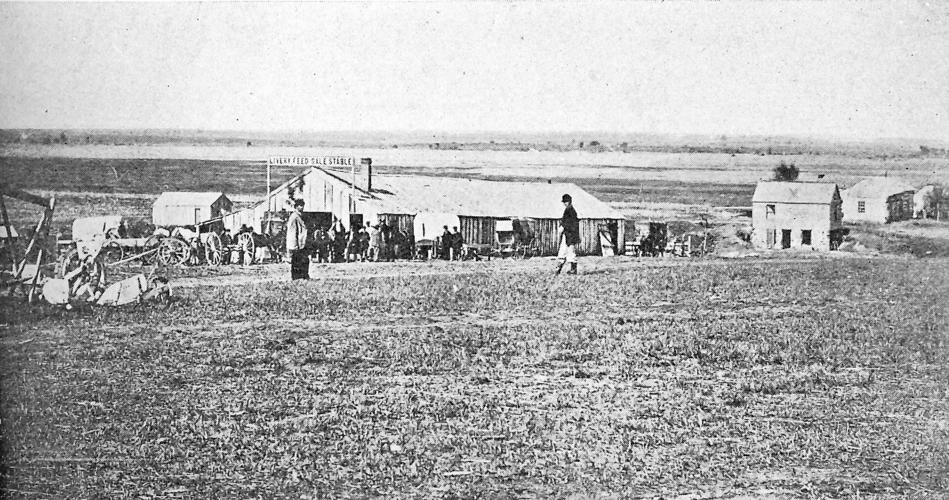
But the horizon was treeless 150 years ago, so the half-dozen houses, church, blacksmith and stores — then the village of Lancaster, and much of it taking root on a barren plain near what is now downtown — could likely be seen for miles.
The horizon was also plump with potential.
In the late 1860s, Lancaster became Lincoln, and Lincoln became the state capital. Its population has snowballed every decade since, except one, and those first 30 settlers are nearly 300,000 today, a 1 million percent increase.

This 1867 photo of what is now downtown Lincoln, likely taken from 10th and O streets and looking southwest, shows the very beginnings of the city’s skyline.
That original low-slung skyline? It kept up — and kept changing — with that growth.
And it still is, with four multimillion-dollar redevelopment projects planned in the next few years, all of them within blocks of Lancaster’s old epicenter, all of them destined to further break the horizon.
People are also reading…
In the beginning
A brief history lesson from Ed Zimmer, the city’s historic preservation planner:
Lincoln boomed as the new center of state government and home to the university, growing to 55,000 people by 1880.
In a young city where the tallest buildings had only climbed to three, maybe four, stories, architects started reaching for the heavens.
With the spires of First Baptist Church at 14th and K streets. The towers of Central Christian, now St. Mary’s. First Presbyterian and First Congregational, on the block that now is home to the Marriott Cornhusker Hotel.
“The downtown skyline would have had a new series of tall churches,” he said. “And a newly finished state Capitol.”
In 1897, builders of the Burr Block — now Security Mutual — broke new ground at 12th and O with six stories, introducing the city to its first elevator.
Lincoln lost 16,000 people that decade, but roared back in the early 20th century.
In 1910, the First National Bank building at 10th and O climbed above all others, with eight stories, and the race was on.
The Burr Block added four more stories a few years later. The Terminal Building at 10th and O rose to 11, as did the Federal Trust building at 13th and N — but both were soon eclipsed by the Sharp Building, with 16 stories.
The city was spreading out, but downtown was growing up.
“In the teens and early '20s, almost every year, there’s a new taller building,” Zimmer said.
The Chamber of Commerce took notice, rolling out a boastful slogan: A New Skyline Every Morning.
The climbs continued. Georgian Place, at 11 stories and 152 feet. The Stuart Building, 13 stories and 158 feet. What is now the Graduate Lincoln, 198 feet. The U.S. Bank Building, Lincoln’s second-tallest at 220 feet.
All of them, though, will remain overshadowed by the 400-foot state Capitol, its prominence as Lincoln’s tallest building protected by zoning height restrictions, its view from beyond the city limits identified by three Capitol view corridors.
But a new No. 2 is going up as you read this.
‘We need to look like Lincoln’
It’s hard to measure a skyline’s tangible value to a city. But as a quick first impression, it can help define and describe its identity.
A good skyline “hints at the vibrancy, and hints at the intention of how things are designed and how things are built,” said former Mayor Chris Beutler.
His administration ushered in the 10-story Larson Building on Q Street and broadened the Haymarket, pushing the train tracks west to make room for Pinnacle Bank Arena and its new hotels, restaurants and residences.
“I think the aesthetic quality of what’s built leaves a long and lasting impression on people,” Beutler said.
Chicago and New York typically top the lists of cities with the most impressive and attractive skylines. But Lincoln shouldn’t try to be Chicago or New York, said Albert Hamersky, an architect who spent 40 years at Clark Enersen Partners, as head of design, president and chairman, and also led the Downtown Lincoln Association.
It should try to be Lincoln.
“I wouldn’t push the skyline just to be pushing it,” he said. “We need to be Lincoln; we need to look like Lincoln.”
And it does, he said, especially from the city’s front yard — Interstate 180, the entryway from the north: Book-ended by Memorial Stadium on one side, Haymarket Park and the arena on the other.
A good look.
“It’s symbolic of who we are. We’re a strong sports city. I think that should provide a good image to people.”
There are other entryways, other introductions to Lincoln that tell more of its story, Zimmer said.
Enter from the east, on Cornhusker Highway, and you’re flanked by railroad tracks, a concrete plant, excavating company and ag processors.
Also a good look. It shows Lincoln is a hard-working city.
“I don’t think it’s bad for a city to have some visible industry,” Zimmer said.
The view from Rosa Parks Way highlights the Capitol; the route from West O carries you past the new West Haymarket and its illuminated parking garages; and the view from the east end of O Street — Lincoln’s original entry for autos — shows from 27th Street what this city has to offer, the tall buildings above downtown a mile away, the taller Capitol off to the side.

The garages near Pinnacle Bank Arena light up in red, green and blue, welcoming visitors to Lincoln.
But a century and more ago, most of Lincoln’s visitors came to the city through its backyard, and they didn’t get these long views.
They’d depart their trains already near the heart of the city — the restaurants and hotels near the depot at 20th and O, or the warehouses of the Haymarket.
That would have been memorable, too, emerging from a long rail ride into the middle of it all.
“Uphill was downtown, and a pretty urban-looking downtown,” Zimmer said. “That uphill piece would give you a sense of arrival.”
Another new view
It’s changing again, with four projects planned squarely at Lincoln’s front door.
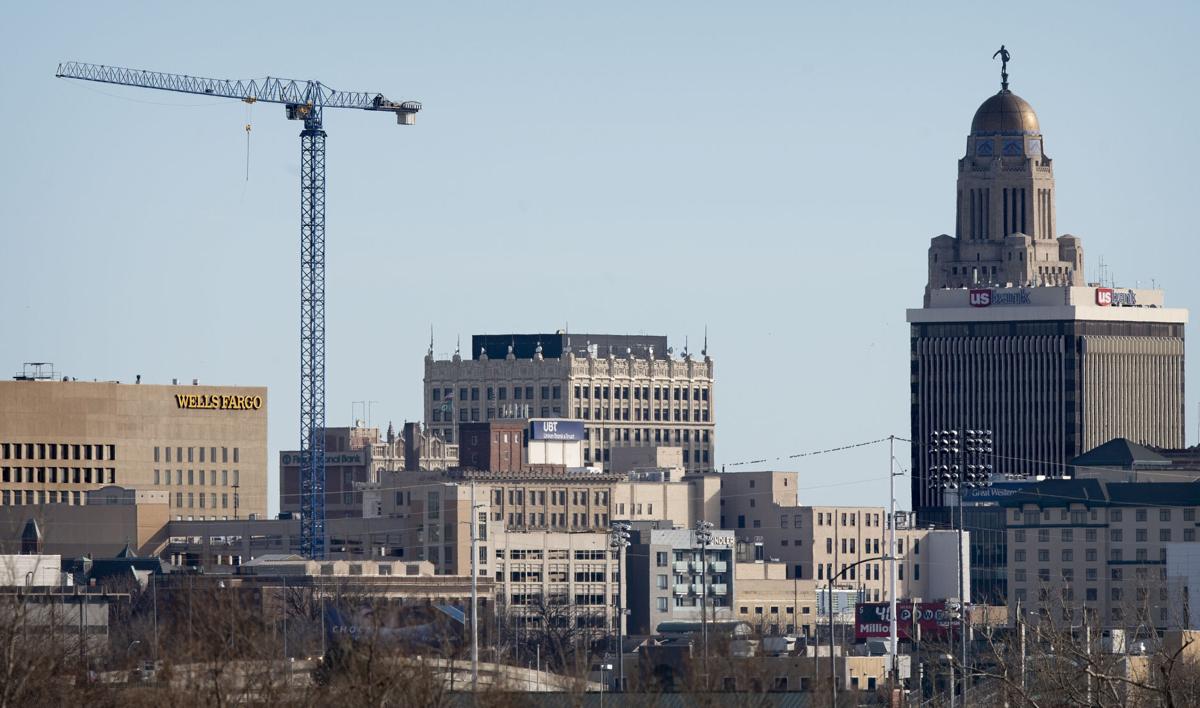
At 11th and Q, a 280-foot construction crane is piecing together Lied Place Residences, a 20-story, high-end condo project that will claim the place as the city’s second-tallest building.

The 20-story Lied Place Residences is rising from a gap on the north side of the Que Place Garage.
At Ninth and Q, Drury Hotels is expected to close in March on the Journal Star’s former printing plant and adjacent parking lot. The Kansas-based company hasn't released any details of its plans, though it operates more than 150 hotels in 25 states, including a new, 22-story property in downtown Nashville.
At Ninth and P, apartment developer Trinitas Ventures of Indiana, which built the 8N Lofts student housing complex, is buying the Journal Star’s headquarters, with plans to replace it with a 13-story apartment building.
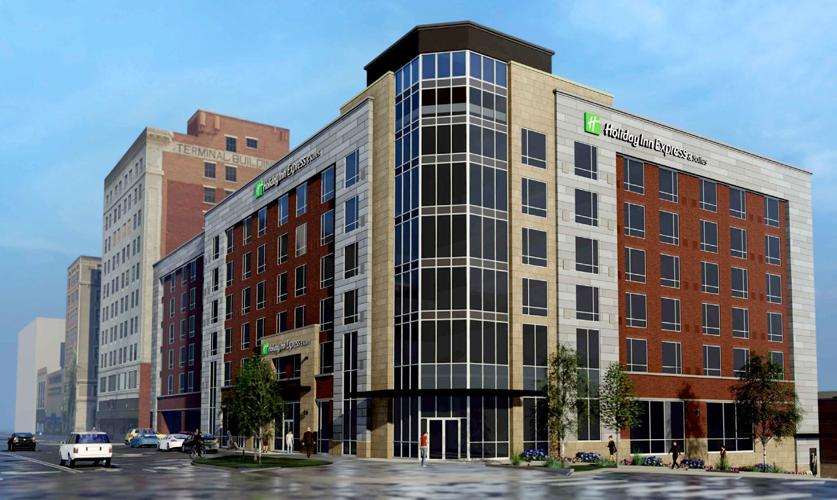
And at Ninth and O, contractors are moving dirt and preparing the site to support a six-story, 140-room Holiday Inn Express.

Renderings show a preliminary design for a hotel on the southeast corner of Ninth and O streets.
All of them scratching the horizon within blocks of Lincoln’s humble and hardscrabble beginnings as Lancaster — and all of them combining to change how Lincoln views itself, and how others will view it from a distance.
The 10 tallest buildings in Lincoln
The 10 tallest buildings in Lincoln
10. Wells Fargo Center

The Wells Fargo building is listed at 148 feet tall by Emporis, although a 1976 Journal Star article lists the height at 173 feet.
9. Terminal Building

The Terminal Building at 10th and O was built in 1916. It is 10 stories and 150 feet tall.
8. Georgian Place

Georgian Place (pictured facing northeast) houses a portion of the downtown YMCA at 11th and P Streets. The apartment building is 11 stories tall and 152 feet. It was built in 1926.
7. University Towers

University Towers, originally known as the Stuart Building, is 13 floors and 158 feet tall. It was completed in 1929. It stands at 13th and P streets.
6. Abel Hall

Abel Residence Hall at the University of Nebraska-Lincoln is estimated to be 161 feet tall.
5. Sharp Building

The Sharp Building, 206 S. 13th St., is 16 floors and 166 feet tall. It was built in 1927.
4. Graduate Hotel

The Graduate Hotel at 9th and P streets is an estimated 198 feet tall.
3. U.S. Bank building

The U.S. Bank building was built in 1969 at 13th and M streets. It is 20 stories tall and 220 feet high.
2. Lied Place

Lied Place Residences is a 20-story retail, office and residential project on the north side of the Que Place Garage at 12th and Q streets. The building is 250 feet tall.
1. State Capitol

The Nebraska State Capitol dominates the skyline in Lincoln, including looking west from 28th and J streets. The Capitol has 15 floors above ground and is 400 feet tall. It was completed in 1932 after 10 years of construction; the cost was $9.8 million in 1932 dollars.
The Capitol stays Lincoln's tallest building because the Lincoln Municipal Code puts height restrictions on structures within the Capitol Environs District.
Reach the writer at 402-473-7254 or psalter@journalstar.com.
On Twitter @LJSPeterSalter

Peter Salter
General assignment reporter