


They told her to stay south of Superior Street, closer to home, so she pedaled north.
Through the dirt of what would be 44th Street, passing the shadow of Bloody Mary's 12-room home. Then further, into the woods.
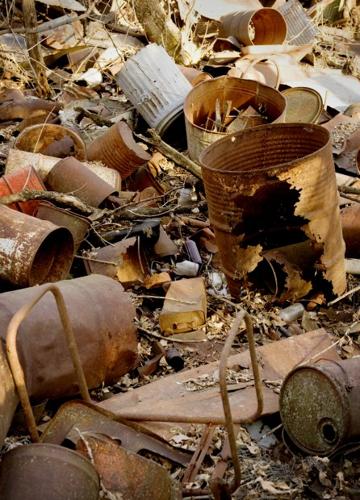
Denise Michels, 8, was drawn to the dumping ground beneath the trees, and the pig man's little house, all smothered in trash and teeming with cats.
This was 1968.
"Back then, we didn't know what a hoarder was. We thought there was something wild about all of this junk all around. As a kid, that was a dream come true."
She never saw the pig man. And she never knew when she'd see one of the animals that fed on garbage and lived inside a fence of bedsprings.
"That was the fun of it: Is a pig going to come out?"
People are also reading…
The bottles were fun to break. Denise and her friends would line them up on a log or a ledge and shoot at them. They never ran out.
She sometimes ran with older kids, teenagers. They were known to taunt the pig man and to terrorize Bloody Mary, who lived alone in her big house. Teenagers had always done that, and, two years earlier, the old woman had shot a young man in the face as he climbed through her window.
But Michels was alone in the woods the day her bicycle chain slipped off. She didn't know how she would get back home to 44th and Colfax. So she climbed the steps to Bloody Mary's porch.
"And I was scared. She killed one boy in 1966. Was I going to be the next?"
The door opened. Mary Partington knelt down, fixed the bike, and the girl pedaled out of the woods and back to the other side of Superior.
* * *
Above the bottles and the pigs and the pig man's house, planes were taking off. And landing. And, at least once, crashing.
For decades, the Arrow Airport, just north of the woods, was one of three serving Lincoln.
It had been owned by the Arrow Aircraft company, which was producing so many planes in nearby Havelock that it ranked as the nation's biggest aircraft builder in 1929.
The company went bankrupt, but the privately owned airport stayed open for years. In 1959, a plane carrying a family of four from Wahoo clipped telephone wires when the pilot approached too low.
A woman who lived nearby heard the crash, but with the phone lines down, couldn't call for help. So she drove to the airport and told the manager. The family and the pilot survived; the phone lines at the end of the runway were moved.
Years later, the city bought the land, turning part of it into the landfill.
The city also considered, seriously, building Mount Trashmore: piling garbage into a 160-foot peak, covering it with dirt and turning it into a ski slope.
* * *
The airport mowed near the end of the runway, and there was something about the short grass that attracted snakes. And a boy named Dick Vaughn.
In the early 1940s, he'd climb on his bike at 27th and Vine streets and be out in the country by the time he reached Cornhusker Highway. Superior Street was gravel, Pig Man's Lane was dirt.
"Snakes, they were a very interesting hobby of mine. Not only how they ate but how they moved. I was into all critters that moved or crawled or walked or flew."
Vaughn is 83 now. But he still remembers the pig man as friendly, a gentleman living in a shanty nearly hidden by overgrowth. He called him "Mister."
"He'd see me and want to know what the hell a young kid was up to."
The boy was trying to win a bet. Everyone told him he wouldn't find a rattler within 50 miles of the city.
He did. A small snake, about 20 inches, with three rattles. He kept it in a gallon fruit jar with holes poked in the lid.
One day, he found the jar empty, its lid unscrewed.
"Later, there was a story about how somebody at about 25th and Y caught one beneath their front porch, and everybody wondered how a rattlesnake got into Lincoln."
The boy kept his mouth shut.
And he grew up to become a supervisor at Antelope Zoo.
* * *
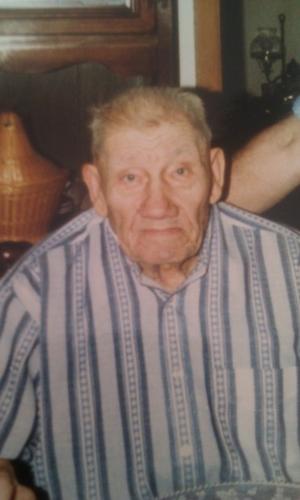
The pig man's name was Clarence Higby, and he was born in 1890.
He didn't own the woods or the pigs, but he took care of them for William Kline, and William Kline took care of him.
By the time Beatrice Hernandez met the two in the early 1970s, they were old men, living at 33rd and Leighton streets. She was Kline's step-granddaughter, and her family moved in next door. They all kept Clarence fed, washed his clothes.
"He'd go sit in an old car in the back of the yard and smoke his pipe, because Bill didn't like smoking."
Clarence had a distinct walk, Hernandez said. He trudged, like he had a hard time lifting his feet.
Kline was the garbage man who filled the woods with bottles and barrels that cover the ground today. He had stopped hauling by the 1970s, but he still would fill his truck with outdated food from restaurants and drive down Superior Street to feed his hogs.
Hernandez used to go with him to what her family called the farm. She'd visit with Bloody Mary and look for apothecary bottles in the heaps. She still has some.
She remembers how dense the woods could feel -- and how far from anywhere it seemed.
Kline was out in his woods one day after Clarence died.
"And he saw Clarence walk by, and he called at him but he didn't turn around. He walked just like him."
Reach Peter Salter at 402-473-7254 or psalter@journalstar.com.

Peter Salter
General assignment reporter


