


Ten years ago, Nebraska was getting ready for a legal fight over radioactive waste that had its origins in the 1970s.
It was one of the most protracted, explosive political and legal battles in Nebraska history, spanning the administrations of four governors and ultimately costing the state millions of dollars.
And 10 years ago this summer, lawyers for the state were girding for the main event -- an eight-week trial that resulted in a federal ruling that Nebraska officials had acted in bad faith in trying to block construction of a waste dump for low-level radioactive waste in Boyd County.
The court file was 10 volumes thick, containing some 500 motions and orders.
The exhibits numbered in the range of 5,000, and some 50 witnesses -- including then-Gov. Ben Nelson -- took the stand.
People are also reading…
In the end, U.S. District Judge Richard Kopf of Lincoln ordered the state to pay $151 million in damages upon finding Nelson orchestrated efforts to undermine building the radioactive warehouse in Boyd County in northeast Nebraska.
"It now seems amazing that Nebraska spent over $25 million dollars trying to defend the lawsuit, and never made the least honest effort to negotiate a resolution until after the judgment," said Alan Peterson, one of the lawyers who helped win the suit against the state.
In a scathing ruling, Kopf said Nelson, now a Democratic U.S. senator, oversaw a warehouse licensing process "littered" with evidence of bad faith.
"Governor Nelson, either directly or through his subordinates, influenced the process in order to fulfill a campaign promise, which required that the license be denied without regard to the technical merits," Kopf wrote. "Frankly, I cannot conceive of a stronger case of bad faith in the performance of a contract."
Nelson made the proposed dump part of his successful 1990 gubernatorial campaign against incumbent Republican Gov. Kay Orr.
And in his ruling, Kopf noted Nelson's campaign promise to Boyd County residents: "If I'm elected governor, it is not likely that there will be a nuclear dump in Boyd County or Nebraska."
"To the extent that Nelson now denies making the statement, that denial is not credible."
Nelson declined to comment for this story.
But at the time, he bitterly denounced the ruling. He maintained the state denied the license because the dump would have posed a threat to the environment and because its proposed developer, US Ecology, was nearly broke.
The battle had its genesis in 1970, when Nevada, South Carolina and Washington grew tired of accepting low-level radioactive waste from the rest of the country.
Congress told states in 1980 to build their own dumps or join regional groups to dispose of the waste, which includes contaminated tools and clothing from nuclear power plants, hospitals and research centers.
Nebraska joined Kansas, Oklahoma, Arkansas and Louisiana in 1983 to form the Central Interstate Low-Level Radioactive Waste Compact.
The other states voted in 1987 to put the dump in Nebraska, and the fight began soon after, with both sides wrangling in federal court on several issues.
Then, state officials announced in December 1998 they intended to deny US Ecology's license application, citing the potential for groundwater contamination and concerns about the contractor's financial health.
Later that month, the nuclear waste generators, which had spent roughly $90 million trying to get the warehouse built, sued the state in federal court on "bad faith" allegations.
The 8th U.S. Circuit Court of Appeals later dismissed the generators as plaintiffs, but allowed the compact, which had joined the lawsuit in 1999, to continue the case.
The trial started in July 2001.
Peterson said the trial revealed that scientists and engineers who studied the Boyd County site had been ordered by state officials "to change their reports and even their calculations from generally favorable for the issuance of the license for the site, to negative.
"They actually were ordered to rewrite and modify their supporting studies to fit a conclusion denying the license," Peterson said. "While some were angry and astounded, they complied and were paid for that work. At trial, this was finally admitted by some of the engineers in view of a few documents found during trial preparation, including a key email that disclosed the political interference in unmistakable, dramatic detail."
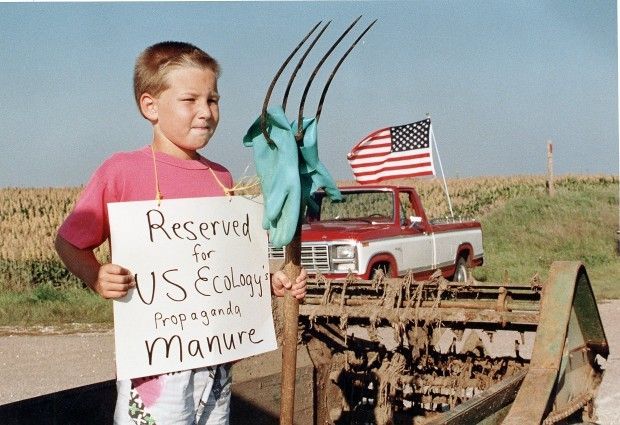
There was grassroots opposition to the dump as well.
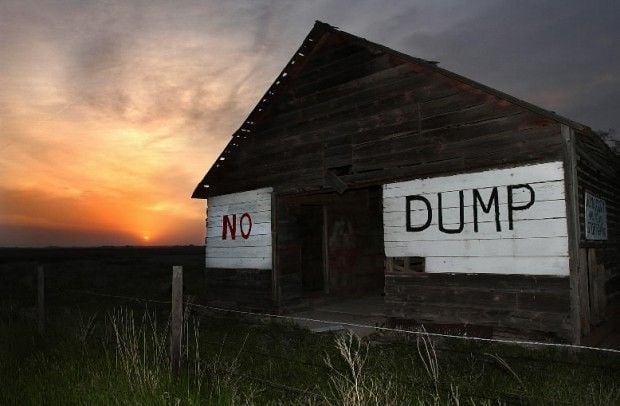
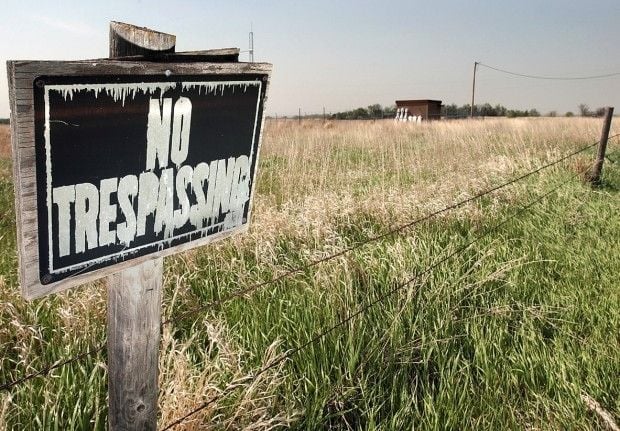
Anti-nuke waste dump signs popped up along roadsides in Boyd County.
Opponents staged canoe races in a water-filled ditch near the proposed site to publicize what they said was an environmentally unsuitable spot for a nuclear waste dump.
They staged mock funerals for the state and for compact officials who attended a meeting in Butte.
Spencer rancher Lowell Fisher, who lives some eight miles from the site, staged a 30-day hunger strike just before the 1990 gubernatorial election.
"I drank water," he said. "Zero calories."
His weight dropped from 177 pounds to 143.
"It gave me the microphone, so to speak," Fisher said. "We had an opportunity to tell our story and hopefully impact the election."
Some say Nelson's opposition to the dump was key to his defeating Orr.
"When you have a problem, you respond to the person who responds to you," Fisher said. "And Ben Nelson came and listened. It was one of those issues that made a difference."
Although Nebraska joined the compact during the administration of Democratic Gov. Bob Kerrey, the state was not picked to host the dump until the Orr administration.
Orr said in 1987 that while she was not thrilled, the state "recognizes its responsibility as a member of the compact and accepts such designation as host state."
Ultimately, as part of the 2004 agreement to drop its appeal of Kopf's ruling and pay $141 million, Nebraska was relieved of its obligation to build the waste site.
It was not until recently that a solution to store much of the nation's low-level radioactive waste was found.
So-called Class A waste, which remains radioactive for as long as 100 years, is being stored at sites in Clive, Utah; Richland, Wash.; and Barnwell, S.C.
Class B waste, which can remain radioactive for as long as 300 years, and Class C waste, dangerous for as long as 500 years, is being stored at Richland and Barnwell.
Barnwell now takes waste only from Connecticut, New Jersey and South Carolina. Richland takes waste from 11 northwestern states.
That leaves 36, including Nebraska, with no place to put Class B and Class C waste.
But a new facility being built in Texas recently got approval to eventually take waste from the 36 states, who will have to apply to send waste there.
Meanwhile, Omaha Public Power District, which has a nuclear power plant near Fort Calhoun, and Nebraska Public Power District, which owns Cooper Nuclear Station near Brownville, are sending their Class A waste to Utah and storing Class B and C waste on site.
Nebraska's former compact commissioner, Gregory Hayden, a University of Nebraska-Lincoln economics professor, remains convinced that had a dump been built in Nebraska, it eventually would have started taking radioactive waste from all over the nation -- and world.
"The other four states could obviously vote to let another state in, and we would have been getting it from the across the U.S. as well as other places," Hayden said.
He said keeping the dump out of Nebraska was "well worth the fight."
"Everyone involved, especially Ben Nelson, needs to be praised."
Said Fisher: "A lot of people kept saying 'Well, there's nothing you can do about it.' But there were enough people who realized it was not a good deal. I'm proud of the opposition effort. I really am."
"We knew what they were doing was wrong, and we were determined enough that it wouldn't happen," he said. "And it didn't happen."


