


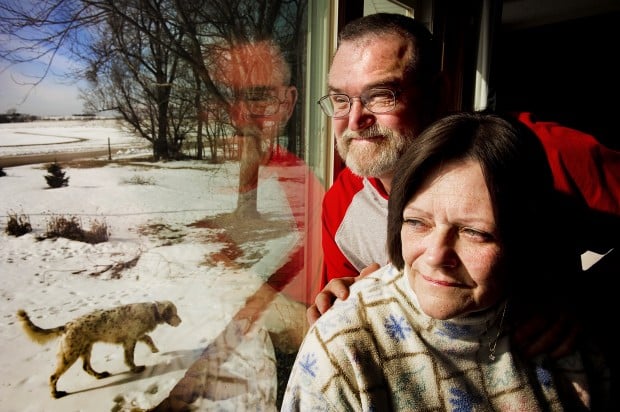
A gunman broke down a rural Greenwood couple's front door on a March afternoon 11 years ago. Not long after, a cop broke down the back door. In the minutes in between, Les and Retha Debrie came close to dying. Today, they're focused on living.
GREENWOOD -- He points first to a spot several inches below his navel, near the button of his jeans, and then toward the top of his head.
"One bullet hit me here," he says. "And one hit me here. Want to see the exit wound?"
Retha watches him from the kitchen table.
"Oh, no, Les. Don't."
She has five gunshot wounds of her own. She has a groove in her arm, carved by a bullet. And she still has lead in her backside, 11 years later. She can feel it when she sits.
Les Debrie's fingers crawl up his cheek and pluck out his right eye.
People are also reading…
He flashes his socket. See?
Then he pops the glass eye back in and continues.
"If I'd been an inch to the south, it would have missed me altogether. If I'd been an inch to the north, I wouldn't be here telling this story."
* * *
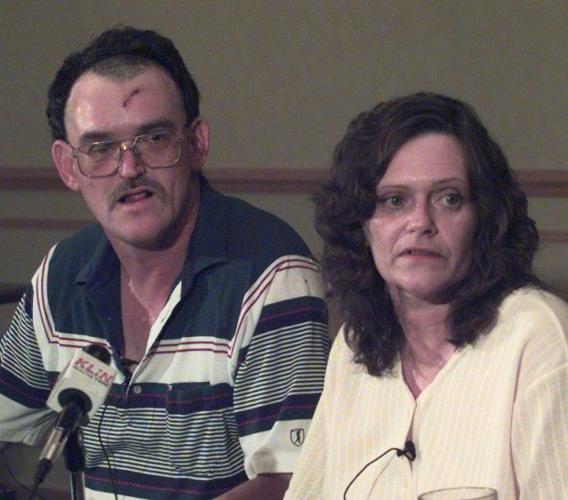
Les and Retha were two days into their long hospital stays when their daughter faced reporters, describing what her parents went through after a March 14, 2000, Lincoln bank robbery spilled into Cass County.
Her parents were just home from work, she said, and had poured themselves iced tea.
The truth is: Retha had grabbed a beer as soon as she walked in the door.
"Up until that point, up until I got home, I thought I'd had a horrible day. I told people at work I'd had a horrible day."
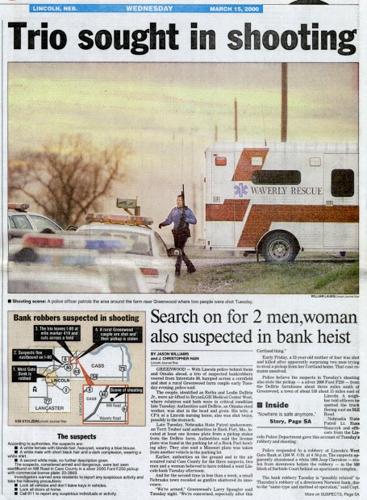
About the time she was driving home from her job in south Lincoln, two brothers -- both armed, both masked -- were storming out of a West O Street bank with nearly $40,000.
They ditched their stolen Jeep near a Capitol Beach apartment and climbed into a Mazda SUV to try to get back to Omaha.
They would be pulled over, they would flee, and they would drive across a cornfield and stop at the first farmhouse they found.
They would begin the end of their days as free men.
They would change Les and Retha's lives, but not as much as you would think.
And they would express regret.
"The kidnapping and the shooting, that was never a plan," said James Allee, who put the bullets in Les and Retha. "I kind of wish people would believe that to hurt people was never the intent."
* * *
The Debries live four miles southeast of Greenwood and nearly two miles from Interstate 80; theirs is one of four homes on a mile-long stretch of gravel.
Retha had just changed out of her work clothes when the SUV turned off Mill Road and tore down their driveway.
It was after 5 p.m. but still light out.
She didn't see its flat tire, or the piece of fence it was dragging.
Les, home from his construction job, was on their computer between the kitchen and living room.
Who came down our driveway like that? Retha asked.
They both looked out the bedroom window closest to the driveway.
Les teased her, like he still does. "I said: 'You goofy old woman. There's nobody there.'"
They were returning to the kitchen when their front door caved in.
Today, Les tells the story deliberately, as if he's memorized a script; he's told it so many times. He moves around the home, showing the where and the how.
The door had been locked, but it was a flimsy, trailer-type door, and James Allee put his shoulder into it.
"He had a 9 mm and he stuck it on Retha. He grabbed an afghan that was sitting on the couch and said, 'Put this on your head.'"
James Allee, 25, held the gun on them while his younger brother Justin moved around the house, pulling what he thought were phone lines (he disconnected their TV and computer, Retha said).
They were there by chance. The brothers and their driver, Sue Bryant, had known they couldn't lose cops on the interstate. So they bumped across a field and turned into the first driveway.
They made a new plan: Tie the couple up inside the SUV, park that in the garage and escape in the couple's brand-new Ford F250.
Justin grabbed the keys to the pickup and went outside. He was soon at the kitchen window, trying to tell James something through the glass.
Retha was on the floor, under the afghan. Les was watching James and the gun.
"James can't decide what the hell is going on and he wants to see it, and he said: 'Come.' He had the gun on us."
Les and Retha followed James to the back door.
This is the moment James Allee wishes he could take back.
"I wasn't a very good home invader, because he pushed me out the door. It was his right to do it, it was his home, but I just panicked.
"And that's when I shot."
* * *
Les is still standing up, telling the story. There are photos of their kids and their grandkids on the wall.
"At this point, I'd like to say I was going to be heroic, but it was a knee-jerk thing."
He simply slammed the door shut on James.
Then the bullets started coming. Les was hit twice, Retha five times. The dryer took one, too, and they're happy to joke it was the only thing killed that day.
Les was out momentarily. But he woke up and called for Retha. "He said: 'The son of a bitch shot me, I think he hurt me bad.'"
And all Retha thought about was saving her husband. She ran through the house, out the front door and to the garage, to get her cell phone from her car. It was dead.
She returned to the house for her keys, thinking she'd drive to the nearest neighbor.
She remembered one of the men cutting the lines, but she checked their home phone anyway. It worked.
The 911 dispatcher told Retha to get a pillow and towels. Retha walked across the house for them, following instructions, waiting to hear sirens.
"I wanted them to get here to give us help. I wanted that more than anything."
Then the dispatcher told her to apply pressure to her husband's wounds, and she couldn't.
"I said, 'I don't feel so good.' And I just kind of slid down the back door."
* * *
Mario Robinson wanted to be a firefighter when he grew up.
He became a cop instead.
But he'd recently completed his EMT training when his police radio sounded three tones -- bank robbery.
Robinson, heading into town on the interstate, turned his cruiser around to look for the SUV.
He was chasing it within minutes, and then the four-wheel-drive left the interstate.
"I don't know any county roads. We were driving around looking for the vehicle. Next thing I realized, our dispatcher said they received a call there were shots fired. On Mill Road."
Robinson has been a Lincoln police officer for 17 years now. He got goosebumps last week, remembering.
They saw the Mazda behind the garage. They saw the door riddled with bullet holes. They didn't know if the shooters were inside.
Retha was still on the line with the dispatcher.
"They could hear her crying, and then they lost contact with her. At that time we made a decision to go inside the house."
Robinson kicked in the door and found Les and Retha on the floor, bloody.
The cops checked the house and Robinson ran back to his cruiser for his medic bag.
"I'm surprised they lived. I didn't think they were going to make it."
Retha's memory of some of those moments is foggy. But she's never forgotten Robinson, the well-mannered medic who likely saved their lives.
"He was so polite. He said, 'Ma'am, I'm going to have to cut your clothes off. Is that OK?'"
* * *
The Allee brothers didn't get far, taking the couple's pickup to Rockport, Mo., stealing a set of license plates and driving back north to Omaha.
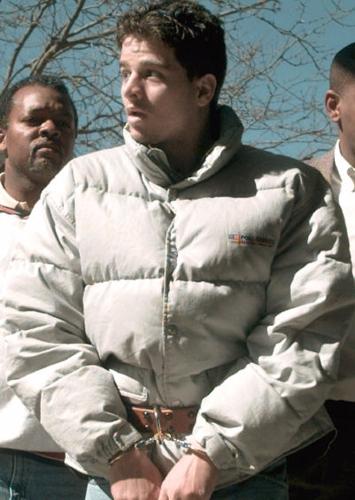
They were arrested two days after the shooting.
Justin Allee is in a Pennsylvania prison, serving a 52-year federal sentence for the robbery. He later pleaded no contest to a 1995 gang-related killing in Omaha, meaning he'll serve another 40 to 60 years of state time.
The woman who drove them out of Lincoln and into the Debries' driveway served more than two years. She lives in northeast Nebraska and hasn't been in trouble with the law since.
James Allee, doing his time in a high-security federal prison in Kentucky, expects to die behind bars. He received a 54-year federal sentence for the robbery, and 30 to 40 years for shooting the Debries.
He wouldn't know what to say if he got a chance to meet Les and Retha again.
"I don't think words would do anything. I said I'm sorry when I was in federal court. And I meant it. But what words can change anything?"
The 36-year-old believes several things: That he and his brother received excessive sentences, that March 14, 2000, was "a very unlucky day for everyone" but a day that made him believe in God. "They didn't die. Thankfully."
He also believes the Debries should move on.
"I've already received a life sentence. I'm not getting out prison. I think they are consumed by hate."
And that's where he's wrong.
* * *
Les was mad, at first.
He told a prosecutor: "If you're going to release him, release him to my front porch. I just need 30 minutes."
He loaded every gun in the house.
And Les and Retha thought about that March 14 every March 14.
But then one year they didn't. The anniversaries passed without notice, although they went out for dinner last March to mark the 10th year.
Les has unloaded his guns -- or most of them.
They renovated their house.
Still, they're surrounded by reminders.
They get small restitution checks. Last year's was the biggest: $30.
Retha, 58, has asthma, and she thinks it stems from being ventilated in the hospital.
"And I have a problem with blood sugar. I have no spleen. I have two holes in my bladder. I lost 10 percent of (a) kidney ... I lost 18 inches of intestines. I had chest tubes, a drain tube and two surgeries to fix incisional hernias."
Her husband's list is shorter, but no less traumatic. He lost an eye.
"And I have a hole in my brain about the size of a quarter."
But they have a resolve: Not to let the bullets define who they are.
Getting married was a bigger deal. So was their son beating cancer.
"I made damn good and sure they didn't change my life," says Les, 59.
Retha looks up again from the kitchen table.
"But we still run back to see who pulls in the driveway."
Reach Peter Salter at 402-473-7254 or psalter@journalstar.com.

Peter Salter
General assignment reporter


