
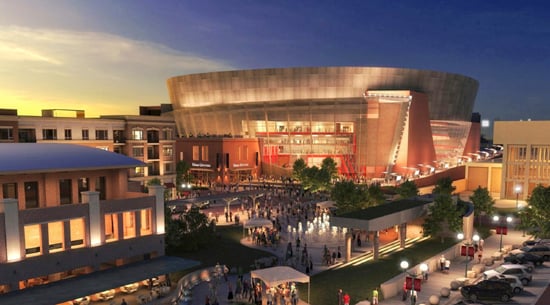
When John Paul Jones Arena opened in Charlottesville, Va., in 2006, the Washington Post said the 15,000-seat arena was so lavish it "would make even an NBA team proud."
The brick arena is outfitted with white columns, pillars and pergolas so it blends in with the University of Virginia's Jeffersonian campus.
Inside, it's modern, with polished concrete and terrazzo floors, banks of video screens on the walls, a retractable scoreboard and seats.
There's a practice gym for the Cavalier basketball teams, and underwater treadmills for athletes nursing injuries.
The arena is one of three Lincoln officials toured in Ohio and Virginia in 2007 and is often mentioned as most similar to the kind Lincoln wants to build.
One big difference is that John Paul Jones also has a basketball practice facility, which Lincoln dropped from its plans when the university decided not to wait and build one adjacent to Devaney.
People are also reading…
Dick Campbell was on the tour, and when he walked in the John Paul Jones Arena, he said, he thought, "Wow."
The Lincoln nursery owner has led efforts to build a new arena here for about five years - and envisions the day the Huskers can play in one just as grand.
Of the three Campbell toured, John Paul Jones was most similar to what Lincoln is proposing in size and scope.
"That is a perfect example," he said.
The University of Virginia built the $191 million arena in part to propel the Cavalier basketball teams to national prominence - which is also part of the rationalization for building a new venue for the Huskers.
Universities nationwide are engaged in a sort of arms race - building flashy arenas to attract recruits and build programs.
Nebraska Athletic Director Tom Osborne has said it's time for the Huskers to join the 21st century by offering the kind of buildings and amenities found elsewhere.
In Charlottesville, that includes individual benches for players in the locker rooms and a TV-dotted dining hall where meals are designed by nutritionists.
"Compared with Pershing, it would be considered lavish," Campbell said. "Compared with what's being done in areas across the country, it would be right in sync."
The city and the University of Nebraska-Lincoln also hope to attract regional NCAA events or the volleyball Final Four.
Osborne says a new venue for the Huskers would help with recruiting, possibly pushing the men's team to the top of the Big 12.
Now, the women's team is undefeated and the men's team is ranked last in the Big 12. Both play in the 33-year-old Devaney Center.
Devaney does not have the premium seating and luxury suites that bring in big bucks and big recruits - and it's not conducive to expansion, although that's Plan B if Lincoln voters reject a new arena.
Nebraska Men's Basketball Coach Doc Sadler has so far been on the sidelines in the debate. While he has pushed for a practice facility - and will get at Devaney regardless of how the arena vote goes - he says a better arena is not important to him.
"I love playing in the Devaney Center. Because the fans are right there and it's just a great home-court advantage," Sadler said. "But at the same time if a new arena is what's best for the city and best for the university, I'm 100 percent for it. ... I'll be very excited one way or another."
He said there's no doubt universities nationwide are duking it out to build the finest facilities.
"But as soon as they build it, somebody else is gonna build a better one," he said.
He said he's lost recruits due to a lack of a practice gym, and his own survey of recruits showed that facilities were their No. 1 consideration - even more important than the coach. Aside from the lack of a practice gym, he said, Nebraska has "phenomenal" facilities, such as the academic center, like skills center and so on.
"Once we get a practice facility there won't be anybody in the country that has better facilities than we do," he said.
The city's financial figures bank on better attendance in a new arena: They estimate attendance at men's games would increase 15 percent and 80 percent at women's games.
Tom Lorenz, who manages Lincoln's Pershing Center for SMG (a private company that manages arenas including John Paul Jones), said Lincoln's arena would be on par with John Paul Jones.
"Certainly we'll have as nice of a building," he said.
Kent Morgan, who coordinated arena planning for the city before retiring last year, also toured arenas in Virginia and Ohio.
He said John Paul Jones was similar to Lincoln's planned arena in terms of scale, size and configuration. Plus, it's a university facility designed primarily for basketball games, but also used for community events from concerts to circuses.
It has a similar number of suites and a horseshoe-shaped bowl that's more flexible for seating configurations.
Campbell said his group asked arena operators what they wish they'd done differently, and at John Paul Jones, they said they didn't build the entrance big enough for circus elephants to get through and had to rebuild it. (Lincoln officials made a note of that.)
Jason Pedone, assistant general manager for John Paul Jones Arena, said the arena is "certainly a showpiece for the athletics department."
As will likely be the case in Lincoln, the arena doesn't sell alcohol during university games, but does during concerts and other events.
Sadler said his team being a tenant in the arena is just a small part of the big picture.
"I think it's a much bigger thing than just basketball," he said. "What the people of Lincoln, Nebraska, have to decide is if it's going to benefit the city enough to do it. ... We're going to be successful either way."
Reach Deena Winter at 473-2642 or dwinter@journalstar.com.