




In Nebraska’s classrooms, clinics, and credential programs, a seat has been vacant for a generation. What would it take to fill it?
by Dr. Joe DiCostanzo, Vice President, Education – Nebraska Children and Families Foundation
The chair
Step into a Nebraska elementary school and look at the front of the classroom: in about three out of four rooms, the teacher is a woman. Visit a healthcare training program and count how many young men are enrolled. Look at a dual enrollment class and see who earned college credit and who did not. In each case, the pattern is the same: a seat that should be filled is empty.
This is not a new problem. The chair has been empty for a long time—long enough that most people stopped noticing it. For decades, boys have been drifting away from Health, Education, and Literacy (HEAL) careers, and the systems that might have reached them, guided them, or opened the way were never built. The chair stayed empty not because anyone said boys did not belong, but because no one clearly made room for them.
People are also reading…
On April 30, Richard Reeves and Saul Valdez of the American Institute for Boys and Men came to Omaha. What they presented that day made the empty chair impossible to ignore.
Why the chair is empty
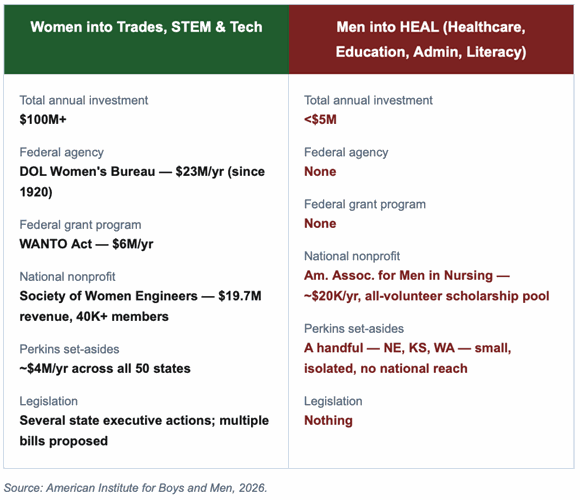
Richard’s presentation examined four areas where boys and men are falling behind nationally—mental health, work and wages, education, and family. Each slide sharpened the overall picture. But the moment that shifted the room came from a simple comparison: everything built over 40 years to move women into trades, STEM, and technology, placed alongside everything built to bring men into HEAL professions.
This is how the chair became empty. Not through malice—the investments made in women and girls in STEM were right, and they worked. Women in STEM succeeded because people decided it should succeed and then built the infrastructure to make it happen, over decades, with real money. A federal bureau. Grant programs. National networks. A chair was set, filled, and held.
The gap is that nobody set the chair on the other side of the table. Men’s share of HEAL professions has been declining for decades. Male psychologists fell from roughly 7 in 10 in 1970 to about 2 in 10 today. Male K–12 teachers dropped from 1 in 3 in 1980 to roughly 1 in 4 now. The college degree gap reversed entirely—women now earn 58 percent of all bachelor’s degrees. And HEAL jobs—healthcare, education, human services—account for roughly 1 in 7 American jobs, with more than 1.6 million additional positions projected over the next decade. The chair is empty. The room needs someone in it. Those two facts, placed side by side, constitute the argument for doing something different.
Nebraska’s empty chairs
The national picture is one thing. Nebraska’s own data makes it local.
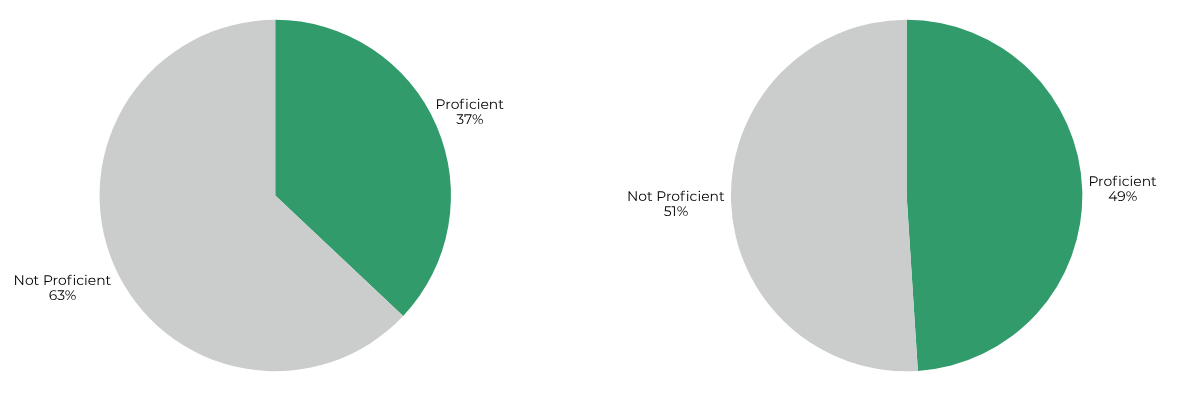
In 2024–25, roughly 55 percent of Nebraska’s 3rd-grade boys scored proficient in English language arts on the NSCAS statewide assessment, compared to nearly 60 percent of girls. The gap at age 8 looks manageable. It doesn’t close. By 11th grade, only 37 percent of Nebraska boys scored proficient in ELA on the ACT, compared to 49 percent of girls—a gap of more than 11 points. Fewer than 2 in 5 Nebraska boys are leaving high school reading at a level that positions them well for postsecondary success. That’s not a ceiling problem. It’s a foundation problem, and it accumulates across every year those boys spend in the system.
It shows up in graduation rates. Nebraska boys graduated at 85.8 percent in 2024–25, compared to 90.2 percent for girls—a four-point gap that has held steady across three consecutive years of data. Thousands of young men each year don’t complete the credentials that open most of the doors worth walking through.
And it shows up most directly in the pipeline for the very professions Boys in HEAL is trying to rebuild. Nebraska’s strategic plan calls for 1,100 students concentrating in education programs annually by 2030. In 2024–25, 183 were on track. Of those, just about 1 in 5 was male. The teaching workforce across the state is 27 percent male, meaning roughly 3 in 4 teachers in Nebraska classrooms are women—and the pipeline behind them skews even more female. The chair at the front of the room has been empty a long time, and the students who might have grown up to fill it are not, in any great numbers, being shown the path.
The dual enrollment data tells a similar story. Among the 2022 cohort, 56 percent of participants were female and 44 percent male. When you look at who actually earned dual credit, the gap widens further: 38 percent of female students did so, compared to 28 percent of male students. The seat in the class that opens postsecondary doors is going largely unfilled by the boys who could be in it.
Who’s already pulling up a chair
Here is what the April 30 midday roundtable made visible: Nebraska is not starting from zero.
Five organizations came to the table that afternoon not with proposals but with evidence of work already running. JAG Nebraska operates 90 programs statewide and has built a boys-in-healthcare camp alongside Methodist Health System and 100 Black Men of Omaha, bringing young men into rooms they were never invited into before. 100 Black Men of Omaha has grown from 86 to 211 students and built out the Jet Cohort career pathway, with Mayor Ewing directly involved. North Star Foundation serves 455 registered youth, focusing on belonging, hope, and agency—the interior work that must happen before any career exploration takes hold. Mary Lanning Healthcare has built CNA and phlebotomy training with up to 80 hours of job shadowing and paid internships for students who complete the program; young men are finishing it. The Nebraska Department of Education came with a new strategic plan with data specific to boys and is already serving as a teacher-apprenticeship sponsor.
“By creating intentional opportunities for exposure, connection, and mentorship, we help them see themselves as valued members of healthcare and their community.”
— Areial McNeil, Career Pathway Coordinator, Mary Lanning Healthcare
These aren’t concepts. These are programs with boys enrolled in them, organizations that pulled up the chair and extended an invitation, and young men who accepted it. The chair isn’t fully occupied yet. But it’s no longer just empty.
The hard reckoning
After the partner roundtable, the afternoon session did something harder. The full group—systems and policy partners now alongside practitioners—took an honest inventory of what Nebraska actually has, what’s missing, and who isn’t yet in the room.
The assets are real. Strong nonprofit collaboration with a no-wrong-door approach. Robust statewide mentoring programs. Career centers and JAG infrastructure. A willing state partner in NDE. A philanthropic community paying close attention. And Nebraska is small enough that the people who need to find each other can actually do it, without layers of bureaucracy standing between them and the work.
The gaps, however, are significant. There is no anchor employer committed to a registered apprenticeship. In-state tuition protections for immigrant youth don’t exist. Youth voice isn’t at the table. The prison pipeline and re-entry pathways are largely untouched. Disaggregated data on gender gaps in literacy and advanced manufacturing is incomplete. And one person said plainly what the room understood: “Vision without funding is a hallucination.”
The group also named who wasn’t in the room: higher education partners, the Nebraska Department of Labor, chambers of commerce, Latino and Hispanic voices, juvenile justice and corrections, father organizations. And young men themselves—with, as someone put it, “a vote and a veto.” The chair at the table was set for the right conversation. Half the people who belong in it hadn’t been invited yet.
That’s the crisis point. The early work is real. And so is the distance between where Nebraska stands and what sustained, scaled investment actually looks like. Pulling up one chair at a time, without the infrastructure to hold people in the room, produces movement without momentum.
What Nebraska has the others don’t
Here is what the day also made visible.
AIBM may spotlight Nebraska’s Perkins approach as a national model in their next policy brief. Nebraska is one of only a handful of states doing this work at all—meaning it is not just ahead, it is helping write the playbook that others will eventually follow. That’s not a small thing. It means Nebraska isn’t waiting for someone else to show the way. The invitation is already on the table.
The recovery in this story isn’t a dramatic reversal. It’s the clarity that comes when a room full of honest people names what is true: the chair is empty, here is why, here is who is already working to fill it, and here is what stands between now and the room being full. Nebraska has the practitioners, the partnerships, the data, and the attention of people at a national level who are watching what happens next.
Filling the chair
The chair that was set for women in STEM didn’t fill overnight. It took 40 years of continuous investment—a federal bureau, grant programs, national networks, Perkins set-asides, state legislation, and enough funders and practitioners who stayed the course long enough for the effort to become infrastructure. The investment reached $100 million a year and the results became undeniable. What started as an invitation became a movement, and the movement changed the workforce.
Nebraska isn’t going to replicate that from Omaha. But it can be one of the places that proves the model works for boys—and proof at the state level is how national infrastructure eventually gets built. HEAL professions need men. Nebraska boys need pathways into meaningful work. Nebraska communities need the workforce those boys could become. Those three things align in a way that is genuinely uncommon, and April 30 was a day that put everyone who can act on that alignment in the same room.
The chair has been empty a long time. It doesn’t have to stay that way.
What would Nebraska look like if it decided to fill the chair—not for one grant cycle, but for long enough that it stays filled? And what is it waiting for?
“The question isn’t whether boys belong in these careers.
They always did.”
1 Smith, B., Hawrami, R., & Reeves, R. V. (2025). The HEAL economy. American Institute for Boys and Men. aibm.org/research/the-heal-economy
2 Nebraska Department of Education. Boys’ Achievement in Nebraska. NDE Strategic Plan data, 2022–2025. NSCAS and ACT assessments; NDE teacher workforce and education pipeline data.
3 NSWERS. Dual Enrollment Special Report, 2025. insights.nswers.org/special-report/2025-dual-enrollment.pdf, p. 37.
4 CDC WONDER data cited in AIBM presentation, Omaha, April 30, 2026.


