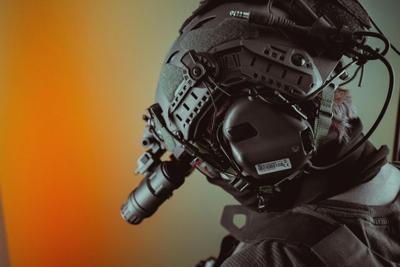


Thermal imaging versus night vision — this debate has been going on since their inception and continues today. Proponents of each technology offer numerous arguments to support their choice. However, if you compare them without accounting for individual preferences, no one has a clear advantage. In some situations, night vision devices are the optimal solution, while in others, thermal optics are the best. Below, we discuss when and under what conditions each technology should be chosen.
Thermal vs. night vision — what's the difference?
Thermal and night vision, although both are designed to improve nighttime visibility, are essentially different technologies. NV operates on the principle of light amplification. It uses moonlight and starlight reflected from objects as its basis. The collected "data" is subjected to various manipulations, resulting in an enhanced image. This image is clearly visible to the human eye and can even be discerned by various small details. The result is a realistic image, comparable to what people see during the day. Thermal imaging works differently. It detects thermal radiation, not reflected light. After processing, an image is generated that reveals the contours of objects and allows one to determine the temperature of each part.
People are also reading…
Pros and cons
Thermal imagers and NVDs are different devices. What they share is a huge number of advantages, making them popular among all types of users. The main advantage of night vision optics is the naturalness of the images they produce. On the screen, the user can better perceive space, more accurately estimate distances, and discern the details of each object. NVDs are also versatile, easy to use, and eye-safe, even during long-term continuous observation. The main advantage of a thermal imager is its ability to operate in complete darkness. Furthermore, it has a greater detection range, making it easier to locate people and animals, and is resistant to backlighting.
Where there are advantages, there are always disadvantages. Both NV devices and thermal imagers have them. The biggest problem for NVD users is always their dependence on lighting. Without it, there's no chance of seeing anything on the screen. Another disadvantage is the possibility of backlighting and a limited detection range. The main problem with thermal imagers is the low information content of the images they produce. It's always more difficult to identify objects and notice details with a thermal imager. Other significant disadvantages include the inability to assess terrain features and a lower chance of detecting inanimate objects.
Choosing between thermal imaging and night vision is always difficult. That's why AGM and other reputable manufacturers offer both night vision devices and thermal models. However, to make a final decision, you need to understand the operating conditions of the optics and the tasks you want to accomplish.