
C.J. Mathis took a swing with his virtual bat and immediately pointed to the upper deck.
That ball was gone and he knew it.
Volunteer Keli Tlamka asked if he thought she could come back from the 4-0 deficit in the Wii baseball game.
"Naw," said the Arkansas basketball player.
She didn't.
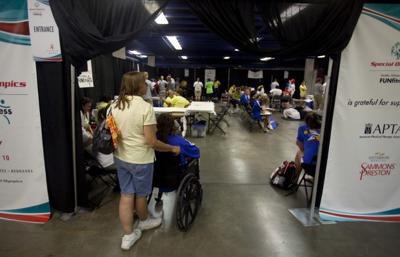
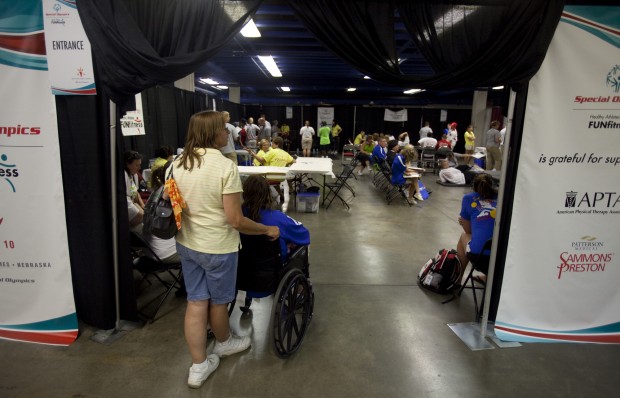
The game was part of an effort to get people with and without disabilities to interact and compete in virtual and real sports like basketball, pingpong and soccer at Special Olympics Town in Pershing Center.
It leads to greater understanding and acceptance, as well as improved social skills and confidence for the athletes, said organizer Josie Cooper.
"It's really rewarding," Tlamka said. "You can tell they're grateful for this event and they're really excited to play.
People are also reading…
"So am I."
The virtual games were only a small part of the activity at Pershing Center on Thursday. She said she and many people who have visited think the goal of creating the feel of an Olympic Village has been accomplished.
Food, music, demonstrations, merchandise, crowds of athletes and coaches and the interactive sports have made the town a hub of activity all week long.
But the basement may be home to the most important and rewarding aspect of the town. More than a thousand athletes have gotten free screenings through the Healthy Athletes program.
The program gave out 200 hearing aids, nearly 1,000 pairs of sunglasses, eyeglasses and sports goggles, and thousands of toothbrushes. It also tested hearing and sight, and it provided dental work.
Program Manager Karl Hejlik said people with disabilities are one of the most underserved populations in terms of health care.
"Many of these athletes don't work full time or have benefits," he said. "Because of that, a lot of doctors and dentists don't want to serve them because their Medicaid doesn't cover all the costs.
"A lot of them have just had to live with decaying teeth, poor eyesight and other ailments -- they might not even know it until they were treated this week."
Dr. Steven Perlman, who worked with Eunice Kennedy Shriver to start the Healthy Athletes program, said the government knows statistics on the primary conditions, but not how disabilities affect their quality of life.
"These are the cream of the crop athletes who can travel and compete," Perlman said. "But think of the kids at the local level who are way worse off -- this is a huge problem and only until recently have people started to take notice."
Reach Jordan Pascale at 473-7120 or at jpascale@journalstar.com.