


The vision of artists, engineers, graphic designers and other "makers" collaborating in one space is becoming a reality.
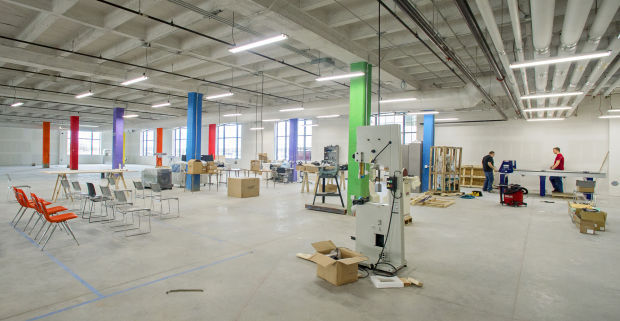
The Nebraska Innovation Studio is under construction. It’s a "maker space" at Nebraska Innovation Campus.
One of the brains behind the concept is Shane Farritor, a professor of mechanical and materials engineering at the University of Nebraska-Lincoln and an Innovation Campus faculty advising board member.
“Think of it like a rec center,” Farritor said. “You pay to use the equipment because you don’t have it at home and you want to be more fit."
With the maker space, "You take classes there and make connections with people with similar interests. A maker space is that for creativity.”
The Nebraska Innovation Studio will offer students and the public a variety of classes, events and -- simply put -- a space to make things.
People are also reading…
“We want to be a cultural hub for the community,” Farritor said.
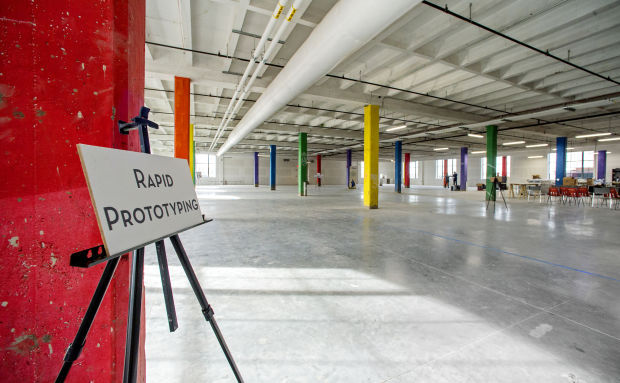
The 16,000-square-foot studio will house several areas for crafts including rapid prototyping, electronics and art, which make up the first phase of the project set for completion by July 1.
The studio also will house woodworking, graphic design and other classes. It also will host a commons area and a mixed-use room.
“The special thing about this is it’s such a mix of everything you can’t get anywhere else,” Farritor said, “at least not in Lincoln.”
At its heart, the maker space encourages teaching, learning, teamwork and, of course, making.
“Once you get 150 people in here doing what they love and talking to other people on Innovation Campus, that’s when the magic is going to happen,” Farritor said.
Members will pay a fee to use the studio as they please. Classes of different price ranges will be open to members and nonmembers.
“There are two barriers for entry-level makers,” Farritor said. “The first is money. Students don’t have a lot. We need to make it cheap for them.
"The second is techability. We don’t want someone coming in to use a table saw if they don’t know how. We want a system that fosters learning.”
Some classes will certify people to use welding, cutting and other equipment. Others will teach how to make pottery, sketch, blow glass or paint with watercolors.
Farritor said the maker space at the Massachusetts Institute of Technology, where he obtained degrees, changed his life.
“I became a better engineer, it broadened my interest in art and it made me a better person,” he said.
When UNL Chancellor Harvey Perlman asked board members what could make Innovation Campus better, Farritor said student involvement. He suggested a maker space.
That was about a year ago, when the UNL Maker Club formed.
The club is one of the largest on campus, according to Jay Carlson, president of the club and an electrical engineering student working toward a Ph.D. The club aims to “fuse engineering, art, design and technology into innovative projects and media,” its website says.
The members are excited for the larger studio. For the past year, the club has borrowed labs and art studios on campus to teach an array of classes.
“My big thing is that we can get all different kinds of people together,” Carlson said. “Our club is extremely diverse. It’s about one-third engineers, one-third artists and one-third other."
Farritor said the club is about 70 percent students, 15 percent faculty and staff and 15 percent unaffiliated with the university.
“Artists tend to be more social whereas engineers focus on their work and are not always great at being social,” Carlson said. “Artists can think about how people interact with an object whereas engineers think about how an object is used.
“That’s what’s really cool about the club, bringing these people together.”
Carlson called Nebraska uniquely suited for a maker space.
“Many students come from farms where if something breaks, they fix it,” Carlson said. “It’s our natural instinct to build.”
He said the spirit of making is sometimes lacking at the university.
“At the university, we graduate students who can’t actually do anything,” he said. “They have all the theory and the math, but if you ask them to design a circuit board, they can’t do it.”
The Nebraska Innovation Studio already is home to one UNL class, Making for Innovation. Its main idea is to show how building and hands-on problem solving are important paths to innovation.


